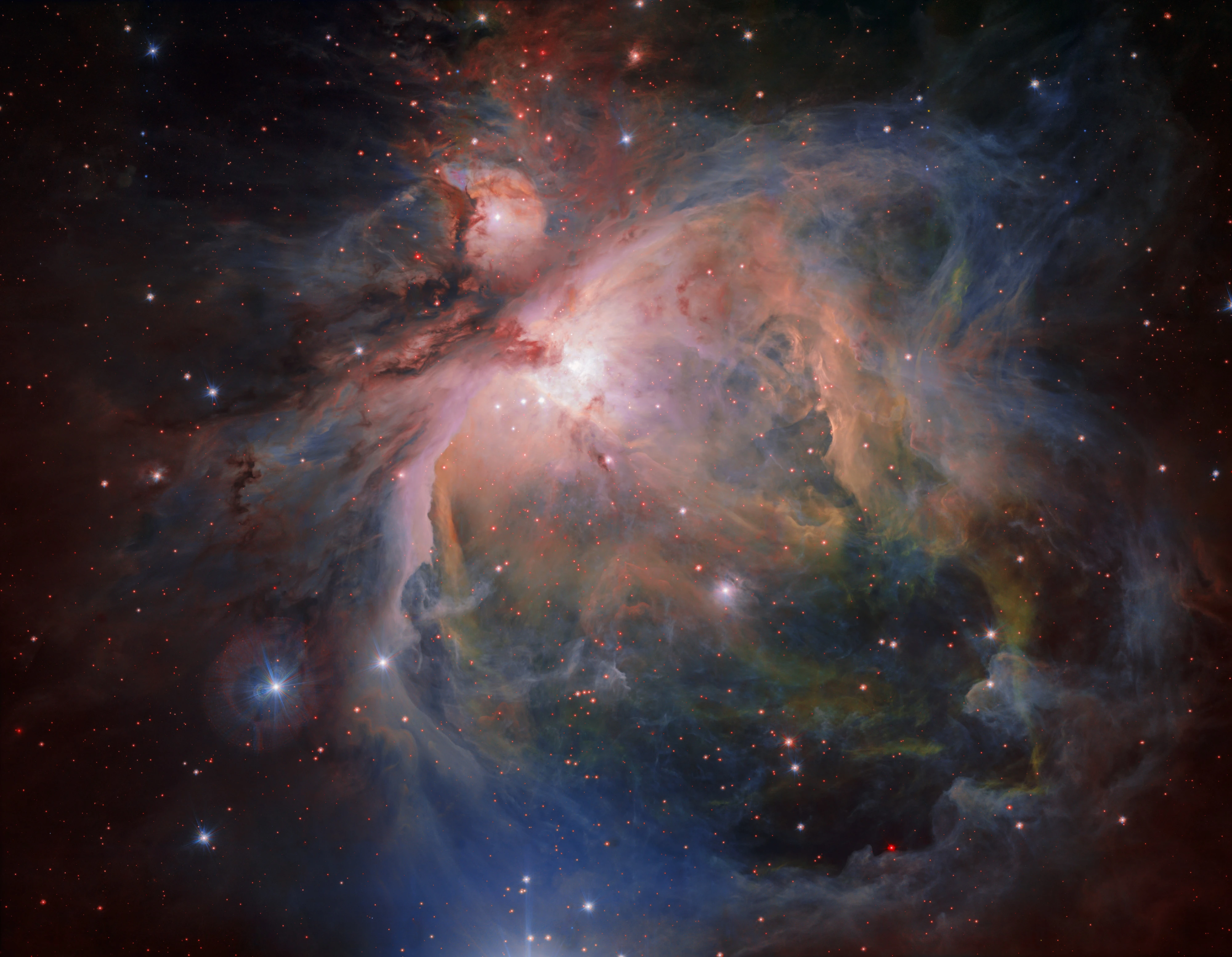
Star Formation Newsletter #401
Lilly Kormann, João Alves | 3 June 2026 | Header image: ESO/G. Beccari
This edition contains the latest abstracts from May 2026.
B-Fields and Star Formation across Scales with TRAO (B-FROST): CO Abundances, Dynamics and Relative Orientations in the Translucent High Latitude Cloud MBM12
In our Galaxy, the average star formation efficiency is of the order of a few percent. We investigated the high-latitude molecular cloud MBM12 as part of the B-fields and star formation across scales (B-FROST) survey with the Taeduk Radio Astronomical Observatory (TRAO) to assess why star formation activity in MBM12 is low. We combine {\it Herschel}-based, locally -calibrated (H) estimates with CO and CO () observations (2.53 at 48) to map (CO), (CO), and [CO/H], compute multi-scale and mass-size scaling laws from dendrograms, and derive the histogram of relative orientations from {\it Planck} dust polarisation. We identify four main regions based on velocities that have H column densities ranging from cm cm. The average (CO) is close to the galactic average, with variations below from collisional de-excitation in low-density gas, and above from CO photodissociation at cloud edges. The hierarchical structures follow a broken power law mass-size relation . The values of ranged from , with the smallest values at 0.1 pc scales. The mass-size relations for the structures with the lowest have scaling factors three times larger than those of high structures, indicating external pressure one order of magnitude larger. We found a transition of parallel to perpendicular between column density structures and magnetic field orientations at (H) cm. We provide the first integrated chemical, dynamical, and magnetic field analysis of MBM12. Scale-dependent mass-size and virial analysis can further constrain the role of external pressure in regulating the star formation efficiency.
Exploring the conditions for forming planetesimals by the streaming instability and planetary systems by pebble accretion
The streaming instability and pebble accretion are two physical mechanisms with demonstrated potentials to drive, respectively, the formation of planetesimals and the growth of planetary systems containing a diverse range of planetary types. Here we explore the protoplanetary disc conditions in terms of turbulence strength, Stokes number and initial disc size that are needed to (i) form planetesimals by the streaming instability, (ii) form gas giant planets in cold orbits, (iii) form super-Earths and sub-Neptunes close to the star and (iv) form rocky planet embryos in temperate orbits. We identify an optimum Stokes number range between St= 0.01 and St= 0.03 where all three planetary classes form and where the streaming instability is triggered for a slightly elevated pebble metallicity. Cold gas giants require a turbulence strength of at most and furthermore need large initial disc sizes to benefit from a prolonged pebble flux; super-Earths and rocky planet embryos tolerate higher turbulence strengths similar to those measured for the vertical shear instability. A higher Stokes number of St=0.1 is detrimental to the formation of cold gas giants due to the short-lived pebble flux. For Stokes numbers below St= 0.003, extremely low values of turbulence () are required to form cold gas giants. We highlight how loss of gas to disc winds, reduction in the migration speed by thermal or dynamical torques or the presence of pressure bumps in the outer disc could increase the parameter space for the formation of cold gas giants. We derive analytically that the mass of the largest planetesimals formed by the streaming instability is of similar magnitude to the threshold mass beyond which pebble accretion becomes efficient, if planetesimals form in the earliest phases of protoplanetary disc evolution.
Systematic underestimation of polarisation angle dispersion and its consequences for magnetic field strength estimates in star-forming regions
Polarised dust emission observations are a valuable tool to infer the structure of the magnetic field and the dispersion of polarisation position angles may be used to estimate magnetic field strengths. A natural consequence of magneto-dynamic turbulence is for the angular dispersion to have a length-scale dependence, making the measurement of angular dispersion non-trivial. In this paper, we present a study of parametrised, scale dependent maps, focusing on the effect of pixel size and beam convolution on the measured angular dispersion when using the commonly employed unsharp-masking and structure function methods. We find that in all cases the measured angular dispersion is underestimated compared to the true value. The degree to which the measured angular dispersion is underestimated varies by factors of 1-10 when measured on scales of 1-3x the beam size, and depends on the underlying structure of the polarisation angle field. This suggests that currently derived magnetic field strengths using angular dispersions are chronically overestimated, potentially leading to an overly magnetically-dominated view of star formation. We present a method to estimate a correction factor to account for this and apply it to JCMT Orion A OMC-1 observations. We find that the magnetic field in OMC-1 is predominately found to vary on scales much larger than the JCMT's 14'' beam and has a rather low degree of unresolved dispersion, leading to a correction factor of only 1.6 for angular dispersion measured at a scale of 14''/0.028 pc.
Chemistry and Isotope Ratios of Substellar Atmospheres in the Pictoris Young Moving Group
Measuring the chemical and isotopic compositions of gas giants and brown dwarfs provides insights into their formation pathways and birth environments. 2MASS J0249-0557 c is an L2-type planetary mass companion () orbiting a pair of brown dwarfs in the Pictoris young moving group. Its mass places it at the intersection of planets and brown dwarfs, making it an interesting target for constraining formation pathways at the planet-brown-dwarf boundary. Using high-resolution spectroscopic data of the planet acquired with CRIRES+ mounted on VLT, we conduct atmospheric retrieval with the radiative transfer code \texttt{petitRADTRANS} and the nested sampling tool PyMultiNest. We retrieve a C/O ratio of , a metallicity of [M/H] = , and a CO/CO ratio of . We also retrieve atmospheric compositions for two benchmark brown dwarfs in the Pic YMG, 2MASSI J0443+0002 and SIPS J2000-7523, using CRIRES+ data and find consistent compositions. Together with 2MASS J0249-0557 c's wide separation from its host, its compositional consistency with other members of its group supports gravitational collapse in a star-like manner as its most likely formation mechanism. These results deliver a homogeneous comparison of three substellar members in the Pic YMG. Their solar-like abundances provide a baseline for exoplanet members in the same moving group, such as Pic b, 51 Eri b, and AF Lep b, whose host stellar compositions are difficult to measure. Future comparisons of atmospheric compositions among this moving group offer the potential to distinguish between formation mechanisms for its planetary members.
JWST-DECO: The Impact of Accretion on Mid-Infrared Observable Water in Planet-forming Disks
The inner few au of a protoplanetary disk hosts the majority of observed exoplanets and is the primary planet-forming zone of the disk. The mid-IR spectra of disks, with its rich forest of water lines, provides key insights into the composition of forming planets. One of the strongest trends seen with data from Spitzer and now JWST is a correlation between the increase in water line flux and accretion luminosity of a system. We set out to reproduce and understand this trend by adding an accretion module to the thermo-chemical code DALI, and explore how viscous accretion heating and the addition of accretion luminosity impacts the 2D temperature structure and the observable water reservoir. We reproduce the trend that the observed water mass increases with accretion rate, with hot, warm, and cool water being more to less strongly correlated, respectively. Our model suggests that these trends are due to an increased emitting area with accretion rate, with some of the cool and warm population becoming hidden underneath an optically thick dust surface and being constrained to a smaller disk volume. This trend is driven by the accretion-related increase in central luminosity, while viscous heating centralized to the midplane has no impact on observed water mass.
Veiling of Photosphere Lines in the Spectra of UX ORI Stars at Deep Light Minima. I. The Star RR Tau
The spectra of RR Tau star, which belongs to the family of young irregular variable UX Ori type stars, in its different brightness states have been studied using a comparative analysis. Selected spectra of the star that are obtained with the Nordic Optical Telescope at various times when its brightness ranged from to have been presented. The veiling of spectral lines at brightness minima by circumstellar emission has been considered, and its origin has been discussed.
Evolution of compressed clouds formed by filament coalescence. I. Oblique collisions
Stars are thought to form predominantly within filamentary molecular clouds. Recent studies have suggested that active star formation, including the formation of stellar clusters and massive stars, occurs within so-called "hub" structures, where multiple filaments converge. Understanding the formation and evolution of such hub-filament systems is therefore essential for unveiling the physical processes responsible for cluster and massive star formation, although the full picture remains incomplete. To address this, we have focused on filament-filament collisions as a potential formation mechanism of the hubs. In this study, we investigate the fundamental evolutionary processes of oblique collisions between two magnetized filaments using three-dimensional ideal magnetohydrodynamical simulations. As a model of initial filaments, we consider two identical finite-length magnetized filaments, varying the collision angle between their long axes, the collision velocity, which is set perpendicular to the long axes, and the initial line mass. We find that as the collision angle decreases from orthogonal to parallel, the compressed cloud becomes more prone to gravitational collapse. In addition, the instability of the post-collision compressed cloud can be explained by its energy balance. Specifically, if the absolute value of the gravitational energy exceeds the sum of the kinetic, thermal, and magnetic energies immediately after the collision, the cloud undergoes gravitational collapse. Conversely, if the gravitational energy is smaller, the cloud expands. In addition, we estimate the upper limit of the collision velocity that enables hub-filament formation and identify the collision conditions favorable for massive star formation.
The Accretion Process on Protostars
The process of mass accretion onto Young Stellar Objects (YSOs) plays a fundamental role in determining the final stellar mass and setting the initial conditions for planet formation. Despite its critical role, our understanding of accretion remains fragmented, particularly for what concerns the earliest, protostellar phases (Class 0/I). While the community has consolidated a comprehensive knowledge of the accretion process of the later-stage Classical T Tauri Stars (CTTSs), a similar level of understanding is critically lacking for the protostellar phase, where the bulk of the mass is assembled. This work aims to review recent major results, both from the observational and numerical point of view, bridging the gap between the two approaches and providing an updated, complete assessment of accretion in protostellar sources. We present different techniques to measure accretion on protostars, analyze how methodological differences affect parameter estimation, discuss the caveats in comparing with numerical models, and suggest the next steps to take towards an ever more exhaustive picture of the protostellar phase.
Tracing the sulfur depletion in starless and pre-stellar cores
Sulfur is one of the most abundant elements in the Universe, yet the sulfur budget inferred from the observed sulfur-bearing molecules in dense cores is significantly lower than expected. Starless and pre-stellar cores represent the earliest stages of star formation and provide a laboratory for studying the physical and chemical processes that cause sulfur depletion. We aim to constrain sulfur chemistry in dense cores by measuring abundances of sulfur-bearing molecules and how they reflect core evolution and environmental effects. We observed nine cores in the Taurus Molecular Cloud, targeting 13 sulfur-bearing molecules, including CS, CCS, CS, OCS, SO, SO, HCS, and isotopologs. Molecular abundances and six abundance ratios were compared to three evolutionary tracers: H column density, ND/NH, and the CO depletion factor. We also compared observations with 0D chemical models with different initial sulfur abundances. We find variations in abundances across cores. L1517B exhibits low abundances and a high depletion factor, whereas L1495B shows enhanced levels in oxygen-bearing species within the L1495 filament. Ratios tracing carbon- and oxygen-bearing species (CCS/SO and CS/SO) decrease with increasing H column density and ND/NH ratio. Other species and ratios show weak or no correlation with tracers. Models reproduce OCS, HCS, and HDCS reasonably well, but not all species simultaneously, especially between carbon- and oxygen-bearing molecules. The variations and lack of consistent correlations suggest that a single evolutionary parameter cannot describe sulfur chemistry and that the local environmental conditions strongly influence the observed abundances. Reproducing the full sample of sulfur-bearing molecules would require improved chemical networks and models that account for the core's physical structure.
Survival of Molecular Complexity under Recent Supernova Feedback: Detection of Hot Cores in RX J1713.7-3946
Protostellar cores located near supernova remnants are considered potential analogues of the birth environment of the solar system. However, the extent to which supernovae influence their chemical evolution remains unclear. We report the first detection of hot molecular cores in a supernova remnant using the Atacama Large Millimeter/submillimeter Array. The detected hot cores (HC1 and HC2) are located inside the X-ray shell of the young supernova remnant RX J1713.7-3946, and both sources are associated with Class I intermediate-mass protostars. This paper focuses on a detailed chemical analysis of HC1, in which a variety of carbon-, oxygen-, nitrogen-, sulfur-, and silicon-bearing species are detected. Excitation analyses indicate that HC1 harbors dense (~10^7 cm-3), compact (<500 au), and high-temperature (>100K) molecular gas. Despite being located within a supernova-feedback region, the column density ratios of complex organic molecules (HCOOCH3/CH3OH, CH3OCH3/CH3OH, and CH3CHO/CH3OH), a deuterated molecule (CH2DOH/CH3OH), and sulfur- and nitrogen-bearing species (OCS/CH3OH and C2H5CN/CH3CN) in HC1 are indistinguishable from those observed in hot cores/corinos in more typical star-forming environments. HC1 is located near the outer edge of the supernova shell, and the surrounding region has likely begun to be exposed to such a harsh environment only recently. The elapsed time since the onset of exposure to high-energy particles and photons may be too short for the chemical composition of the hot core to be significantly altered, and/or the hot-core region may be shielded by magnetic fields amplified by supernova feedback, which could suppress the penetration of enhanced cosmic rays.
The Line Ratio from 100 Molecular Clouds in the Large Magellanic Cloud
We analyze the line ratio of the CO (2-1) to CO (2-1) rotational transitions observed from new ALMA observations of 100 Giant Molecular Clouds (GMCs) that span the Large Magellanic Cloud. We measure a median line ratio of with of the sample falling between 0.058 and 0.107. A regression analysis confirms a nearly linear relationship across two orders of magnitude in line luminosity. Moreover, we find that the inclusion of from Young Stellar Objects as a predictor variable of the line ratio significantly improves the quality of the fit, with clouds hosting IR-bright YSOs having relatively brighter CO emission. This analysis indicates that active star forming molecular clouds have different internal conditions than more quiescent clouds.
Evidence for Systematically Larger Dust Grains in Upper Scorpius Relative to Taurus Disks
Infrared spectroscopy provides a powerful diagnostic for probing the mineralogical properties of dust grains in the terrestrial planet-forming regions of protoplanetary disks. The Upper Scorpius association offers an excellent laboratory for studying disk evolution because it represents an evolved stage (5-10 Myr) compared with younger star-forming regions such as the Taurus Molecular Cloud (1-3 Myr). In this work, we present mid-infrared spectra of 11 disks in Upper Scorpius that were obtained with the Mid-Infrared Instrument aboard the James Webb Space Telescope. We derive emission feature indices for crystalline olivine and pyroxene centered at about 9.2 micron and 11.1 micron, as well as perform spectral decomposition to quantify dust crystallinity and characteristic grain size. These results are compared with those measured from Spitzer/IRS spectra of 31 disks in Taurus with similar stellar types. We find no significant difference in dust crystallinity between the two groups, suggesting that crystallization is largely established at early stages of disk evolution. Our analysis indicates that the average grain size in Upper Scorpius disks is systematically larger than that in Taurus disks, aligning with theories of dust evolution. We also observe a trend of increasing grain size towards later-type stars, as well as a correlation between crystallinity, grain size and the flux ratio F24/F8, which serves as a measure of dust settling. These results suggest that dust processing proceeds in tandem with disk evolution.
Characterizing the Extended Molecular Hydrogen Winds in Protoplanetary Disks from the JWST Disk Infrared Spectroscopic Chemistry Survey
We present a comprehensive analysis of extended H emission from 34 protoplanetary disks observed with the JWST Disk Infrared Spectroscopic Chemistry Survey (JDISCS), supplemented by archival data. We investigated the morphology, kinematics, excitation conditions, and mass dynamics of H. Extended emission from pure rotational H lines is found to be common, with 16 sources exhibiting clear signatures of disk winds. These include monopolar and bipolar structures in inclined disks and ring-like or bubble-like morphologies in face-on systems features indicative of wide-angle disk winds. Our analysis shows that the H is consistent with slow {(4.2 km s)} MHD driven winds. For ten disks, we model the wind morphology and find a median half-opening angle of and a characteristic power-law index of 1.6. Excitation analysis yields a median gas temperature of 624 130 K and a column density of . The median wind mass-loss rate, , implies that, if molecular winds are the dominant mechanism responsible for disk dispersal, a typical disk with a mass of would dissipate on a 2-3 Myr timescale, consistent with observed disk lifetimes. The span a relatively narrow range (2 dex) and do not correlate strongly with accretion rates onto the star, suggesting that the mass loss rate and the accretion rates are probing different timescales. Our findings demonstrate that spatially extended warm H emission is a widespread and reliable tracer of molecular disk winds in protoplanetary systems.
When Magnetic Fields Sculpt the Sky: The Riegel-Crutcher cloud in optical polarization
Filamentary structures are ubiquitous in the interstellar medium, yet the extent to which magnetic fields influence the morphology of cold atomic gas remains an open question. The nearby Riegel-Crutcher cloud, composed of long and narrow H I filaments observed in self-absorption, provides a critical test case. We present the most extensive optical polarimetric survey of this region to date, comprising more than 90,000 high signal-to-noise stellar polarization measurements combined with Gaia DR3 data. Using stellar polarization, extinction estimates, and archival Na I absorption data, we locate the cloud at a distance of pc, consistent with that of the Pipe Nebula. The plane-of-sky magnetic field traced by optical starlight polarization closely matches that inferred independently from Planck 353 GHz dust-emission polarization, revealing a coherent large-scale magnetic field across the region. A Rolling Hough Transform analysis shows that the H I filaments are tightly aligned with this field orientation. Together, these results provide strong observational evidence that the structure of the cold neutral medium in the Riegel-Crutcher cloud is closely linked to a highly ordered magnetic field. This level of coherence supports a scenario in which magnetic fields play a dynamically important role in shaping the cloud structure, and suggests that the Riegel-Crutcher cloud is part of a larger magnetized complex influencing gas flows in the solar neighborhood.
Dense cores and filaments in M16: Enhanced formation efficiency in the stellar feedback-driven shell
We present a comprehensive analysis of dense cores and filamentary structures in the M16 Eagle Nebula using high-resolution () surface density and temperature maps derived from \textit{Herschel} observations. Using the \textit{hires} algorithm for map construction and the \textit{getsf} method for source and filament extraction, we identified 233 cores and 111 filaments in this massive star-forming region. The filaments exhibit a median width of 0.4\,pc – and a median linear density of 61\,\,pc, with 76\% being supercritical for gravitational fragmentation. Our radial analysis of the 60\,pc diameter shell driven by the central NGC 6611 cluster reveals strong enhancements in structure formation: filament formation efficiency (FFE) is 2.3 times higher within the shell (peaking at 22\%), while core density shows a concurrent 1.5-fold enhancement. The moderate correlation between core density and FFE () indicates coupled formation processes. Theoretical analysis demonstrates that observed surface densities exceed the critical threshold for fragmentation by a factor of 8, with a fragmentation timescale (1.5—2.0\,Myr) comparable to the shell's dynamical age (1.0—1.3\,Myr), indicating we are observing fragmentation in progress. These results reveal a hierarchical fragmentation sequence – shell compression filament formation core formation – providing clear observational evidence for positive feedback where massive star formation triggers secondary structure formation in the surrounding molecular cloud.
7DT Insight: Variability in Young Stellar Objects
Photometric variability in young stellar objects (YSOs) provides critical insight into the mechanisms of mass accretion, disk evolution, and circumstellar extinction in early stellar evolution. We present an analysis of day-timescale optical variability in the Orion A central region using two-night 7-Dimensional Telescope (7DT) medium-band photometry obtained on March 23 and 24, 2024. The 7DT observations provide optical spectral sampling with 16 medium-band filters spanning 400—825 nm, enabling direct two-epoch comparisons. To remove satellite-trail contamination, we used an SSIM-based ResNet classifier (accuracy 0.97; F1 = 0.93) to exclude affected exposures. Subsequent photometry and two-epoch variability measurements yielded a working sample of 769 YSO candidates, among which we identified 110 variables (14\%), including seven extreme cases with mag. To describe the wavelength dependence of the variability, we compared five simple templates: extinction-like changes ( 3.1 and 5.5), a gray (wavelength-independent) change, and two spot-like toy models (hot and cold) implemented as two-temperature surface mixtures. The best-fit results are dominated by spot-like templates (37 cold-spot and 22 hot-spot objects), with 37 sources best matched by extinction-like templates and 14 by the gray template. The m650 excess fraction is higher in the hot-spot and gray templates than in the others. This could be compatible with more frequent line/veiling-related contributions in those groups, although the m650 excess is not a direct accretion diagnostic.
Radio Continuum and Water Maser Monitoring of the Outburst in HOPS 373: Free-Free Emission Does Not Respond to the Outburst
We present VLA C-band (5~cm) continuum, K-band (1.3~cm) continuum, and water maser (22.235 GHz) monitoring of the protostar HOPS-373. We additionally present the contemporaneous monitoring for 95 sources within the 5~cm field of view for over two years during the peak of the HOPS-373 outburst and an additional epoch in 2026. HOPS-373 is a binary Class 0 protostar located in the Orion star forming region that was found to have a 4 luminosity burst from the JCMT Transient Survey and NEOWISE monitoring. We do not find evidence for a change in the free-free emission traced by VLA 5~cm continuum during the peak of its outburst or during the decline. Moreover, the 1.3~cm continuum does not show significant variability between the NE and SW components of the HOPS-373 binary. The water maser emission is highly variable toward HOPS-373, multiple velocity components are detected at different (or the same) times and the maser spots are located close to the 1.3~cm continuum source of HOPS-373-SW. There is tentative evidence for the water maser spots to be propagating away from the source, but there is not a robust connection between the outburst and the observed maser activity. The lack of correlation between outburst and free-free emission from HOPS-373 indicates that the free-free emission may not directly respond to increases in the accretion rate and subsequently the outflow rate. The lack of a link could be due to the outflow mostly being neutral, or there may be offsets in the timescale for the free-free response.
Discovery of a Compact Hub-Filament System in G286.21+0.17 with JWST and ALMA: Insights into Protocluster Formation and Competitive Accretion
We present a multi-wavelength study of the massive protocluster G286.21+0.17 (G286) using \emph{JWST} near-infrared imaging and ALMA HCO(1—0) observations. The \emph{JWST} images uncover a compact (0.5 pc) hub-filament system (HFS), comprising a dense central hub connected by at least four converging filaments seen in absorption, along with multiple H protostellar jets/outflows. The hub hosts dense core G286c1. The HCO emission confirms this HFS over [19.2, 16.4]~km~s. The \emph{JWST} images further trace prominent photodissociation regions around the H\,{\sc ii}~region~A, powered by a B-type star. The radial distribution of ALMAGAL 1.38 mm core properties reveals steep power-law slopes toward the hub center. Within the inner hub (r < 8'', ~pc), the core number density follows , the surface density scales as , and the enclosed core mass varies as , while core diameters remain approximately constant (). These trends, along with filament mass accretion rates of —~~yr, support a competitive accretion scenario in which gravitational focusing enhances core growth toward the hub center. Filament linewidths increase from tail/outer-region to head/hub-region, consistent with gravity-driven turbulence. However, the absence of a preferred alignment between velocity gradients and gravitational force directions may indicate a dynamically evolved system. The HFS likely formed through large-scale gas layer interactions and compression by the adjacent H\,{\sc ii} region. Overall, star formation in G286 appears regulated by filamentary accretion, competitive core growth in the hub, and stellar feedback.
Kinematic properties of the TW Hya association
A kinematic analysis of the young stellar association TWHya has been performed. The components of the displacement matrix in the Ogorodnikov-Milne linear model have been estimated both graphically and by solving the basic kinematic equations. The association's volume expansion with a coefficient of km s kpc was confirmed, which yields a dynamical age estimate of Myr. Using the graphical method, estimates of the association's proper rigid-body rotation parameters around the galactic axes x and y have been obtained for the first time, with velocity values in the range of 50-70 km s kpc and errors in their determination of 14-19 km s kpc. However, these values are not confirmed by another method. For example, when solving kinematic equations only using proper motions, all three components of rigid body rotation do not differ significantly from zero, km s kpc.
Fragmentation in the Serpens/Aquila Star-forming Region
We present a population study of Atacama Large Millimeter/submillimeter Array (ALMA) Cycle 6 observations of the 100 most gravitationally unstable dense cores in Aquila using a simple mass versus size analysis. We identify 66 continuum sources from ALMA 12m observations at 106GHz and through comparisons with known protostellar catalogs; two of these detected dense cores appear to be completely starless, without any accompanying/nearby protostar detections. Additionally, we find nine other starless ALMA 12m detections within protostellar cores that have fragmented into a mixture of starless and protostellar substructures. We test the turbulent core collapse model by conducting synthetic observations of turbulent magnetohydrodynamical simulations of collapsing starless cores in order to predict how many starless cores should be detected given their central density and density profile. The simulations predict at least one (1.19) detection, consistent with our two detections of ALMA 12m emission within completely starless cores. We also use a combination of ALMA Compact Array Cycle 4 observations and the Herschel Gould Belt Survey data to analyze how mass is distributed on three distinct spatial scales, in order to understand how turbulence shapes the evolution of substructure development as dense cores collapse to form new star systems. We find an increase in multiplicity at the smallest scales when the parent larger-scale structure also has a higher degree of fragmentation.
Self-gravity in thin protoplanetary discs: 2. Numerical convergence solved and revealing the overestimation in mass of formed planets with softening
The Gravitational Instability (GI) is a leading theory for explaining early planet formation in massive discs. In the early 2010s, 3D SPH simulations of GI failed to converge, initially attributed to resolution-dependent viscosity but later appearing in 2D SPH and grid-based simulations, suggesting a numerical artifact inherent to the 2D approximation of gravity. Recently, we derived from first principles a much improved prescription for gravity in 2D discs (via a Bessel kernel). This prescription introduces a characteristic length below which gravity smoothly transitions from a 3D to a 2D scaling. This cannot be captured by standard smoothing length approaches, widely used in 2D simulations. We employ this new prescription to resolve the convergence issue of GI in 2D, and compare the outcomes of GI in runs using the Bessel kernel with those obtained using softening prescriptions at high resolution. We conducted numerical simulations with the FargoCPT code, where the Bessel prescription was implemented. The 2D Bessel formalism of gravity effectively resolves the convergence issues encountered in 2D simulations. When compared to simulations employing softened or unsoftened potentials, I observe that a small softening parameter tends to overestimate gravitational effects. This results in an artificially high number of fragments, leading to final fragment masses that are overestimated by a factor of 2-3. Conversely, employing large softening parameters inhibits gravitational effects. Although our analysis initially suggests that a softening parameter of 0.6 H might offer the best compromise, in reality, the resulting fragments fail to remain gravitationally bound-a behavior not observed when using the Bessel kernel. Our findings strongly suggest that the Bessel prescription should be adopted to ensure a consistent and accurate treatment of gravity in thin discs.
Simulating Star Formation and Star Cluster Assembly in the Aquila Rift Using Archival Observations
We simulate star formation and star cluster assembly inside a molecular cloud with parameters we derive directly from observations of the Aquila Rift. We model the evolution of stars and gas together while resolving close encounters between stars, the formation of new stars, and stellar feedback to follow cluster formation up to the expulsion of the surrounding gas. We find that star formation takes place in clumps spaced unevenly along Serpens South and that these clumps accrete surrounding gas to grow and form new stars. Gas flows along the filament promote the merger of these clumps into a star cluster inside the Serpens South filament. The imprints of these mergers are seen in the dynamics of the Serpens South cluster in the form of velocity space anisotropies, cluster rotation, and cluster expansion. Before gas is removed from the simulation, the Serpens South cluster merges with the nearby cluster W40 non-monolithically resulting in a fractal cluster at the end of the simulation. The dynamics inherited from the mergers throughout the simulation are still seen in the final bound stellar system after the gas has been removed. We compare these results with recent observations of Milky Way clusters to comment on their formation histories. We also study how our results change when lowering the mass resolution of our simulation and removing observations of dense gas tracers from our initial condition setup. Each of the three simulations result in different final cluster configurations pointing towards the importance of gas in cluster assembly.
On the isotropy of viscosity in accretion discs
Accretion discs are fundamental to many astrophysical systems, providing the conversion of gravitational potential energy into radiation that we can observe. In many systems there is evidence that discs are warped; from spatially-resolved observations of protoplanetary discs, to the features of lightcurves and line profiles from discs around supermassive black holes in galaxy centres. The dynamics of warped discs is largely controlled by the physical nature of the internal disc viscosity. While typically disc viscosity is hydromagnetic in origin, simulations of magnetized discs cannot match observed rates of angular momentum transport in planar discs and thus cannot be used to determine the ratio of the torques responsible for driving accretion to those responsible for evolving the disc warp. The analytic work of Ogilvie is the most comprehensive model for warped disc evolution, but makes assumptions that need to be tested. In particular, it assumes that the disc viscosity is Navier-Stokes, and therefore small-scale and isotropic. Here we attempt to test this model using the long periods of X-ray binaries that are due to precession of the disc. These systems have well-constrained estimates of the component of viscosity responsible for driving accretion, and by looking at systems with and without evidence for disc misalignment and precession we can constrain the component of viscosity responsible for flattening the disc. We conclude that the observational constraints suggest that the Ogilvie model provides an adequate description of the disc evolution, but that there are indications that the internal disc viscosity might be marginally non-isotropic.
From streamers to stars: overcoming mass loss in protoplanetary disks
Recent high-resolution observations have revealed filamentary accretion flows (``streamers'') in protoplanetary disks older than 1 Myr, suggesting that late-stage interstellar gas infall (late infall) may affect disk evolution and stellar accretion. In Lupus, observations report a positive correlation between ambient gas density and stellar accretion rate. However, it remains unclear whether infall can truly boost stellar accretion, because incoming gas may instead be lost through photoevaporation or magnetically driven disk winds, or remain trapped in the outer disk. We perform one-dimensional long-term (1—10 Myr) disk evolution simulations. We first treat late infall as a mass source and then include the effective torque arising from the angular-momentum difference between the infalling gas and Keplerian disk gas. We find that even if substantial gas reaches the outer disk ( au), much of it is eventually lost through photoevaporation. Sustained stellar accretion therefore requires efficient inward gas delivery by mechanisms that locally remove angular momentum. Without an effective infall torque, strong viscosity can provide this transport, but it also drives outward angular-momentum transport and excessive disk spreading, inconsistent with the compact disk sizes observed in Lupus. In contrast, MHD disk winds can remove angular momentum without significantly expanding the disk, allowing late infall to sustain stellar accretion while keeping disks compact. Thus, if the Lupus accretion—density correlation is caused by late infall without an effective infall torque, efficient angular-momentum removal by MHD disk winds is required. By contrast, when the effective torque is included, the angular-momentum mismatch itself can promote inward gas transport and enhance stellar accretion, even without strong MHD disk winds.
Exploration of the inner region of the system HD 142527
HD 142527 is a well-studied intermediate-mass T Tauri star surrounded by a transitional disk with a large dust cavity, spiral structures, and an accreting low-mass companion. Despite extensive observations, the system's inner regions remain poorly understood, particularly regarding their influence on disk morphology and planet formation. This study aims to investigate the inner region of HD 142527 (<50 au) with high detection sensitivity thanks to dedicated postprocessing methods to search for undetected components and explore their potential role affecting the disk's structure and evolution. We analyze high-contrast imaging data obtained with VLT/SPHERE applying PACO and REXPACO algorithms, dedicated respectively to the detection of point-like sources and to the reconstruction of circumstellar disks with high reliability, while relying on both angular and spectral variations. We revisit the known companion HD 142527 B and update its photometry, astrometry and accretion rate estimates. Furthermore, we identify a new candidate companion (CC) at an angular separation of ~0.09" (~14 au), although it may also be a disk feature. Otherwise, it could be a young gas-giant planet or a brown dwarf with a mass of 15-50 M_\rm{Jup}. Additionally, we report the discovery of a tightly wound H spiral feature in the inner disk, reconstructed for the first time by high contrast imaging. The spiral implies varying accretion dynamically linked to the known companion B and possibly to CC, suggesting ongoing interactions that influence the disk's structure. Our findings provide new insights into the complex interactions within the HD 142527 system, highlighting the role of multiple companions in driving disk asymmetries and facilitating planet formation. Future high-resolution observations and dynamical modeling will be essential to fully understand the system's architecture and evolution.
An SMA Molecular Inventory of the Edge-on Protoplanetary Disk Gomez's Hamburger
Gomez's Hamburger (IRAS 18059-3211, GoHam) is a massive, edge-on protoplanetary disk that is potentially gravitationally unstable and hosts an overdensity that may be the site of a forming giant planet, making it a particularly interesting source for the study of planet formation in the direct collapse scenario. In this study, we present a molecular inventory of GoHam's disk combining several Submillimeter Array observations for a wideband survey at an angular resolution on the order of ~1 arcsecond. We detect 11 different molecules, including 15 individual lines, and measure their disk-integrated fluxes. We also infer column densities for several species over a range of fixed excitation temperatures. We find that the molecular inventory of GoHam and the inferred column densities for select molecules are broadly consistent with the general population of large protoplanetary disks. We explore the putative gravitational instability (GI) in GoHam's disk via possible enhancements in the gas-phase HCO abundance, but find no definitive evidence of GI. The results of this study can guide future, higher-resolution studies of GoHam, as well as efforts to characterize the giant protoplanet candidate GoHam b.
Evidence of triggered star formation in the Pillars of Creation from JWST observations
Stars form in molecular clouds under the influence of their local environments, yet the role of massive stellar feedback in either triggering or suppressing star formation remains a fundamental question in astrophysics. The Pillars of Creation in the Eagle Nebula, sculpted by ionizing radiation and stellar winds from massive stars in NGC 6611, offer a natural laboratory for investigating this question. Here we present high-resolution observations of the Pillars of Creation using the JWST Near Infrared Camera and Mid-Infrared Instrument, revealing 253 young stellar object (YSO) candidates. These YSO candidates show spatial correlations with the edges of feedback-driven structures, with overdensities along the boundaries. A weak trend of decreasing stellar age with increasing distance from the ionizing source was tentatively observed. There also appears to be an enhancement in the star formation rate within the past 1 Myr in this region. Such age and spatial associations suggest that while the bulk of the YSOs may have formed contemporaneously with the central cluster, a subset could be associated with triggered star formation. The JWST image of intricate structures, including a spiral-like disk and bi-reflection nebulae at the tips of Pillar I and Pillar II, further highlights the complexity of star formation processes.
Diverse dust vertical height and settling strength conditions in protoplanetary discs
The settling of dust particles plays a critical role in the growth and dynamics of dust grains. We performed a detailed modeling of the ALMA continuum substructures for six highly inclined protoplanetary discs using radiative transfer simulations, to constrain the vertical height of millimetre dust grains and the settling strength. Our modeling results are a very thin millimetre dust disc in T Cha ( 0.1 au throughout the disc), a vertically extended dust disc in DoAr 25 ( of 4.7 au at 140 au) and tentatively a thin disc in MY Lup ( 0.5 au at 70 au). From lower resolution observations we found a very thin disc for PDS 111 ( 0.1 au throughout the disc) and a more vertically extended millimetre dust disc in V409 Tau ( of 1.3 au at 35 au). We could not measure the vertical height in the asymmetric disc of RY Lup. We also found that the input dust opacities are a source of degeneracy in our models. Our tentative results, assuming the Ricci dust opacities, point to a diverse settling strength in our sample and possible radial variations. We also compared the models that best fit the ALMA data with the SPHERE data to test if they can reproduce the vertical distribution of small dust grains. This comparison suggests that models that reproduce the dust density distribution in the midplane cannot reproduce the distribution of small dust grains in the upper layers, reinforcing the need for more complex models.
Velocity-resolved [O I] 63,145 um, [C II] 158 um, and OH mapping along the Orion BN/KL explosive outflow and irradiated shocks
Stellar mergers produce explosive outflows that serve as transient sources of IR line luminosity and inject mechanical energy early into the natal molecular cloud. We present the first velocity-resolved maps of the [O I] 63 and 145 um fine-structure line emission from the wide-angle outflow in Orion BN/KL, the nearest explosive outflow. The data were obtained with SOFIA and include sensitive [C II] 158 um and OH maps. They allowed us to disentangle the quiescent cloud gas from the outflow, traced by a broader [O I] component with a line FWHM of about 20-30 km/s and exhibiting a spatial distribution similar to that of the shock-excited H2 emission seen with JWST. The OH 119 um line shows a prominent P-Cygni profile covering 160 km/s, similar to the very broad CO lines. The total [O I] 63 and 145 line luminosity is remarkably high, 86.5 L_sun, comparable to the H2 and CO line luminosities, implying an outflow mass-loss rate of (9.1+/-2.6)x10^-3 M_sun/yr and a mass of 3.3-5.9 M_sun. The [O I] 63 / 145 and [O I] 63 / [C II] 158 intensity ratios reach very high values in the line wings (20-30 and 40-60, respectively), exceeding those found in PDRs. These ratios are consistent with the presence of dense (10^5 to 10^6 cm^-3 ) and warm (~500 K) postshock gas. We analyzed the fine-structure line-wing intensities using magnetized shock models that include UV irradiation, to which the [C II] 158 line intensity is particularly sensitive. We find that the [O I] and [C II] intensities are consistent with emission from dissociative J-type shocks with velocities of 30-40 km/s and preshock gas densities of a few 10^4 cm^-3, illuminated by external UV radiation generated by surrounding fast shocks and possibly by massive (proto)stars in the region. We also report a broad [O I] emission feature around the BN star, which we attribute to an unresolved outflow or wind bow shock.
Dust dynamics in disk dust traps and late planetesimal formation
The streaming instability is the leading model for planetesimal formation in protoplanetary disks, but it typically operates within the first ~Myr. In the Solar System, however, some planetesimals (the chondrite parent bodies) formed 2-4 Myr after disk formation, implying that dust must have been retained for extended periods. Pressure bumps efficiently trap dust, but trapping alone does not guarantee planetesimal formation: even modest gas turbulence can inhibit vertical settling and radial concentration, preventing dust density from reaching Hill density. This motivates the study of alternative dust-gas instabilities, such as the Dusty Rossby Wave Instability (DRWI). We investigate the viability of such instabilities in global disk simulations using the multi-fluid code fargOCA. We first reproduce previous 2D shearing-box results in a global 2D viscous disk and characterize the dust clumping produced by the DRWI. We find that the instability is suppressed in fully 3D viscous disks by unperturbed high-z gas layers caused by dust settling near the midplane. We then explore the inviscid limit and find that multiple dust sub-rings form, concentrating solids into thin ring structures. These would appear observationally as a single radially broad, vertically thin ring, explaining observed protoplanetary disk rings without invoking anisotropic turbulence. Dust concentrations in the sub-rings may remain below the threshold for gravitational collapse, but gas photoevaporation enhances dust settling and radial concentration, eventually forming dense dust clumps in both viscous and inviscid cases. We conclude that planetesimal formation within dust-trapping pressure bumps is favored in very low-viscosity disks at late evolutionary stages, after sufficient gas removal by photoevaporation. This is consistent with the inferred late formation of chondrite parent bodies in the Solar System.
Quantitative Spectroscopic Diagnostics for FU Orionis-Type Young Stellar Objects
We present near-infrared spectroscopic diagnostics that can be used to identify FU Orionis stars (FUOrs). FUOrs are young stellar objects (YSOs) that are currently in a state of extreme outburst, caused by enhanced mass {inflow} from their accretion disks. The disks give FUOrs a distinct multi-temperature optical and infrared spectrum. Considering both the predicted spectrum from a disk atmosphere model, and existing spectral diagnostics from the literature, we identify key atomic and molecular features for characterizing FUOrs. Some of the chosen features are proxies for temperature, others are sensitive to surface gravity, and still others probe disk winds. Using the Palomar Observatory/Hale Telescope TripleSpec spectrograph, we gathered near-infrared spectra of 28 known FUOrs. We use standard equivalent widths to determine the strength of atomic lines and we design several band ratios for measuring molecular features. We compare the measurements between our spectra and a control sample of late-type dwarfs and evolved stars from the Infrared Telescope Facility Spectral Library. By considering the relative distributions of these samples in our defined spectral diagnostics, we propose a number of parameter spaces that can distinguish FUOr disks from normal stars. The rate of discovery of FUOr candidates has increased significantly in recent years, largely due to the increasing prevalence of time-domain surveys. Our proposed diagnostics will allow new photometric candidates to be confirmed or refuted as such.
From inter-filamentary gas to filaments and hubs: gas flows in the Mon R2 hub-filament system
Hub-filament systems (HFSs) play an important role in the formation of massive stars and star clusters. Although the velocity structures along dense filaments have been studied, the gas kinematics in the low density inter-filament regions has not been investigated. We use CO ( = 1—0) and CO ( = 1—0) observations obtained with the Nobeyama 45 m telescope to study the gas dynamics towards the Monoceros R2 (Mon R2) HFS. From the CO and CO data, tracing low- and high-density gas, respectively, we identify velocity coherent structures and divide them into filaments (Fs) and inter-filamentary regions (IFs). We estimate velocity gradients () and mass accretion rates () along () and across () the Fs and IFs. The mean ratio of to in Fs is 6.8, while that in IFs is 1.5. These results show that the overall gas within both Fs and IFs flows directly into the hub and the gas flows faster along the Fs than the IFs. In addition, we found that at least 30\% of the gas mass in the IFs may flow towards the Fs replenishing the latter with new matter. Our study reveals the importance of considering the total gas mass reservoir, both low- and high-density, infalling into the hub and promoting the formation of massive stars, which are preferentially located in the hub of Mon R2.
TRINITY: A coupled model of winds, radiation, and photoionised gas in molecular clouds. I. Methods and validation
Multi-wavelength surveys place cloud dispersal at 1-5 Myr after massive stars emerge, before the first supernovae. Whether a cloud disperses, re-collapses, or leaks Lyman-continuum (LyC) photons depends on how pre-supernova winds, radiation pressure, and photoionised-gas pressure () couple to the shell. We introduce TRINITY, a 1D thin-shell code that succeeds WARPFIELD. TRINITY evolves the bubble-shell structure under winds, supernovae, direct and dust-reprocessed radiation pressure, , and gravity. A phase-aware prescription drives the shell with the larger of the hot-bubble and photoionised pressures when energy-driven, and plus ram pressure when momentum-driven. The initial cloud may be uniform, a piecewise power law, or a Bonnor-Ebert sphere; shell structure, hot-bubble cooling, photon absorption, and LyC escape evolve with the dynamics. We validate against analytic wind and photoionisation limits and survey clouds of mass -, core density - cm, and star-formation efficiency -. enlarges the shell radius by roughly 17% at 10 Myr in the fiducial run. At higher efficiency, the energy-driven phase lasts under 1 Myr, radiation pressure stays sub-dominant, and remains dynamically important in the momentum-driven phase. Cloud structure sets both phase durations and outcomes: at fixed mass, core density, and efficiency, homogeneous and shallow clouds re-collapse while a steep cloud keeps expanding, and Bonnor-Ebert clouds disperse roughly 55% later than homogeneous ones. Thus and cloud structure both shape feedback-driven expansion even when the stellar population is fixed. TRINITY is an efficient, interpretable framework to map feedback dominance across cloud parameter space and resolved H II regions.
Destructuring the disk of AB Aurigae: Dynamics and accretion
In this paper, we present near-IR polarized images of the AB Aur disk at three epochs spanning 3.85 years with SPHERE/IRDIS, as well as Halpha images obtained with SPHERE/ZIMPOL at a single epoch. The purpose of this study is to analyze the dynamics of the entire disk and of the various structures in near-IR polarimetry, and to identify sources of Halpha emission to derive constraints on their mass accretion rate. The dynamical study in the near-IR shows that the disk globally follows Keplerian rotation, but we observe a departure from this behavior at radii smaller than ~60au. At the smallest radius of ~25au, we measure a deviation from Keplerian rotation as large as ~12deg over 3.85 years, demonstrating sub-Keplerian rotation. The two bright spirals within the millimeter cavity have different dynamic trends, and we discuss their possible link with the identified planet candidates. We also discuss the implications of the non-Keplerian behavior, and we posit that it could be related to interactions with multiple protoplanets orbiting out of the disk plane on elliptical orbits. Furthermore, the orbital analysis of the compact sources (labeled f1, f2, and f3) suggests that their orbital planes are significantly inclined with respect to the disk plane by several tens of degrees. The variability of the shadows suggests that they are produced by optically thick regions located within ~60au. For the photometric analysis in Halpha, we derive a flux of about 8.22x10^{-15} erg/s/cm^2 for the entire feature f1, but only 6.46x10^{-16} erg/s/cm^2 at the location of AB Aur b, consistent with non-detection. If f1 were a point source and the accretion remained constant for 1Myr, it would correspond to ~5-20 Jupiter masses according to the magnetospheric accretion model or ~6-10 Jupiter masses according to the boundary layer accretion model.
The bound origin of low-mass stellar binaries
Most main sequence stars, unlike our Sun, belong to multiple systems with two or more stars. How and when these multiples come together and become bound is uncertain, since the earliest stages of star formation are difficult to resolve. We analyze simulations of star cluster formation in Milky Way-like conditions, including all key physics and stellar feedback mechanisms, to understand how multiple systems form. We show that of binaries are gravitationally bound from the moment the second star forms. Binaries evolve and accrete together, which will affect their planetary systems and chemical evolution. Half of the binaries are disrupted by the end of the star-formation epoch, such that of the final single stars belonged to a multiple at some point, with implications for the stellar initial mass function. Formation in multiples is the dominant mode of star formation, accounting for at least 57% of stars.
A fast tree algorithm for multi-component coagulation equation
Dust properties, such as mass and porosity, impact planet formation directly. Understanding the time evolution of dust distribution across multiple properties requires numerical computation. However, available ways to calculate the multi-component coagulation-fragmentation are highly time-consuming. This study aims to develop a fast and accurate algorithm for multi-component coagulation. We assumed that two pairs of colliding aggregates reproduce a similar outcome if the dust properties are similar, and that the ratio of dust properties in logarithmic space gives the similarity as a "distance". These assumptions enable us to apply the tree algorithm, which groups distant bins and calculates interactions together, to coagulation. The algorithm reduces the computational complexity from to , considering bins per components. We tested the algorithm by comparing it with the conventional direct method for cases where analytic solutions are known. We measured the dependencies of the wall-clock time, error in the distribution, and relative error of the total mass, on the , opening angle , and maximum dust distribution width after coagulation . The algorithms are found to calculate coagulation consistently. For , the tree method is faster than the direct method for a specific range of parameters. For , however, the tree method is faster for all parameter regions surveyed, speeding it up by tens of times. Increasing and decreasing or made it slower and more accurate. Additionally, using a small performs worse than when using a large , suggesting that limiting is unnecessary. We present a fast tree algorithm for the multi-component coagulation equation. It will enable us to evolve the multi-component dust distribution, such as in mass-porosity space, in protoplanetary disks.
RAYTHEIA: A high-performance ray-tracing algorithm for three-dimensional direction-dependent equations in astronomical simulations
We present RAYTHEIA, a high-performance reverse ray-tracing algorithm designed to efficiently solve three-dimensional direction-dependent equations in astronomical simulations. The algorithm uses a dual-grid framework in which the native simulation mesh – serving as the source grid for ray emission – and an adaptive mesh refinement (AMR) Cartesian contribution grid are constructed for efficient ray-walking and contribution accumulation. The core of the algorithm integrates a leaf-only linear-octree data structure to reduce memory overhead, the digital differential analyzer (DDA) traversal method to efficiently determine the ray-walking path, Morton Code indexing to fast leaf cell lookup during traversal, and the slab method to analytically compute the path length. Furthermore, RAYTHEIA employs a hybrid (MPI/OpenMP) distributed parallel framework with a chunk-to-chunk communication strategy, achieving exceptional, near-ideal linear speed-up ratio and delivering high-end performance. We integrate RAYTHEIA with the 3D-PDR code to solve the complex chemistry and radiation transfer in photodissociation regions (PDRs). This allowed the modelling of three-dimensional PDR chemistry in a turbulent, star-forming cloud at an unprecedented resolution of grid cells. The algorithm demonstrates accuracy and convergence even at low angular resolutions. We further showcase the capabilities of RAYTHEIA by producing high-resolution synthetic emission maps of key diagnostic lines of a star-forming region capturing physical effects such as [O I] m self-absorption, measuring the [C I]-bright but CO-dark molecular gas, and deriving a CO-to-H conversion factor in agreement with observations.
BISTRO Survey: Gravity-Dominated and Magnetically Regulated Star Formation in M17 SW
We present high-resolution magnetic field maps of the M17 SW molecular cloud using JCMT 850 m dust polarization at a scale of 14. The magnetic field exhibits a distinct arc-like structure that encircles three dense clumps (C1, C2, and C3). By combining polarization data with ammonia line observations, the plane-of-sky magnetic field strength, measured using the Skalidis-Tassis method to minimize angle dispersion errors, ranges from 0.1 to 2.4 mG (mean: 0.54 mG). Energy budget analysis reveals a hierarchy dominated by gravity ( erg cm), which exceeds both magnetic ( erg cm) and turbulent ( erg cm) energies. Since all three energy densities lie within one order of magnitude, gravitational dominance acts primarily as the global driver, while the system remains in a state of near-equipartition. Structurally, the northeastern boundary shows magnetic field lines perpendicular to the shock front, consistent with compression from the adjacent HII region. Within the cloud, magnetic field lines generally align with gravity to assist collapse, but turn perpendicular to gravity within curved accretion bridges. This configuration provides support against radial collapse while guiding gas flow. Kinematic evidence suggests that these channels transport material from Clump C3 onto the massive Clump C2. Star formation in M17 SW is globally driven by gravity but locally regulated by the magnetic field structure.
Fizzy water ice in space: CO adsorption, binding energies and its fate in a protoplanetary disk
CO2 is the third most abundant ice component found on dust grains in star-forming regions and a common ingredient of exoplanet atmospheres. Characterization of its adsorption properties on ices through the binding energy (BE) is essential for accurate astrochemical modelling and understanding chemical inheritance in planet formation. We aim to derive an accurate BE distribution of CO2 on water ices. Our goal is to understand the impact of the BE distribution on the abundance of gaseous and frozen CO2 in a generic protoplanetary disk and the spectral absorption features of frozen CO2. The ACO-FROST procedure is used for computing the BE distribution, where CO2 molecules are adsorbed on several sites of an amorphous water ice grain model. The BEs are computed using an ONIOM scheme. The BEs of CO2 follow a bimodal Gaussian distribution characterised by the following parameters: μ1 = 1648K, σ1=229K, μ2=2339K, σ2=274K.For each BE bin, the pre-exponential factor was estimated using two models and the Polanyi-Wigner relationship. Comparison with previous studies, both experimental and computational, show good agreement on the range of the BEs. The impact of the adsorption on water ice on the spectral features of CO2 molecule is evaluated. The coverage simulation shows the non-wetting properties of CO2 on the water ice surface. We discuss the impact of using a BE distribution and different pre-exponential factors to calculate the partitioning between the ice and gas in a generic protoplanetary disk. We confirm that the use of BE distribution to model the gas and ice fractionation in a protoplanetary disk causes the gas fraction to be significantly more extended. Furthermore, we show that the prefactor has a significant impact on where the snowline forms and on the final extent of the gas fraction in the disk.
The ESO SupJup Survey. X. A carbon isotope contrast in the young ROXs 12 system
Emerging research suggests that elemental and isotopic ratios of exoplanet and brown dwarf atmospheres may serve as potential tracers of their formation pathways. The ESO SupJup Survey aims to shed light on this hypothesis, with a focus on the CO/CO ratio, by investigating the atmospheric composition of substellar companions and isolated brown dwarfs. In this work, we aim to characterize the atmospheres and determine the ratios of CO/CO of the Rho Ophiuchus X-ray source (ROXs) 12 system (6Myrs), consisting of an M0 host with an L0 companion, as part of the ESO SupJup survey. Using high-resolution CRIRES+ K band spectra of these objects, we perform atmospheric retrieval analyses to derive their atmospheric properties, including the CO/CO ratio. Our retrieval framework is built on the radiative transfer code petitRADTRANS, with which we generate model spectra based on equilibrium chemistry tables computed with FastChem, coupled with the nested sampling algorithm PyMultiNest. We report the presence of HO, CO, CO, and HF in both the star and companion, with a tentative detection of HO in ROXs 12B. The CO/CO ratios of the two objects show a measurable, though not strongly significant, difference, namely and for ROXs 12A and B. We measure a C/O ratio of 0.540.01, while the C/O ratio of the star is not reliably constrained due to the absence of atomic oxygen lines in the K band. Furthermore, we retrieve moderate veiling in the host star of =. Systems such as ROXs 12, in which both star and planet can be chemically and isotopically characterized, are crucial for constraining potential formation mechanisms of massive, wide-orbit super-Jupiters.
The Persistent Missing Mass Problem in Planet Formation
Recent ground-based microlensing surveys suggest that our Galaxy may abound with small free floating planets, potentially up to 21 such planets per star. We explore the implication of such possibility on the mass budget for planet formation. When the microlensing planets, both bound and free-floating, are taken into account, along with the short-period planets, T Tauri disks have insufficient mass to source the mass of known planets, even if all the solids convert into planetary bodies. Younger Class 0/I disks can help resolve the problem but generally fall short of the required mass when variable planet formation efficiency from pebble or planetesimal accretion is taken into consideration. If the free-floating planet mass function is as bottom-heavy as reported, heavier Class 0/I disks may be necessary. Alternatively, free-floaters may preferentially form in the most massive disks around massive stars consuming the majority of the mass budget, leading to a decrease in the bound planet occurrence rate for higher mass stars, which is observed. Precise constraints on the bottom of planet mass function are necessary: a peaked mass function may eliminate the missing mass problem; by contrast, verifying a bottom-heavy function could spell a crisis in planet formation.
An extended catalogue of Herbig-Haro objects
We present an extended catalogue of 1193 Herbig-Haro (HH) objects, comprising 477 isolated HH objects and 716 HH knots, compiled through a meticulous review of the literature available through mid-2025. The catalogue provides comprehensive data for each entry, including celestial coordinates, distances, knot separations, exciting sources (with spectral types where available), object characteristics, and bibliographic references. We also perform a preliminary statistical analysis of key parameters such as distance, exciting source properties, morphology, and excitation state. By combining our extended catalogue with the two earlier HH object catalogues published by Hippel et al. in 1988 and Reipurth in 2000, astronomers can access comprehensive information on all known HH objects, thereby facilitating research on star formation and stellar outflows.
Lithium-rich M-dwarfs at the ZAMS: Evidence for planetary engulfment?
We identify 6 early M-dwarfs, in 3 open clusters (NGC 2451a, Blanco 1 and NGC 2516) at ages of 50-200 Myr, that are anomalously enriched in lithium compared with Li-depleted siblings of similar spectral type. The Li-rich outliers represent 2-3 per cent of stars with in clusters at those ages but are otherwise indistinguishable in their positions, parallaxes and kinematics from other cluster members; their placement in absolute colour-magnitude diagrams is incompatible with being much younger Li-rich interlopers, only one shows evidence of binarity and they are all slow rotators. The enhanced Li abundances are consistent with the engulfment of 3-10 of volatile-depleted planetary material after the formation of a radiative core has ended rapid pre main sequence Li depletion. Published planetary formation simulations featuring engulfment via dynamical interactions, and the preponderance of Earth-like exoplanets in close orbits around M-dwarfs, offer some support to this scenario. The observed occurrence rate would be a lower limit to the frequency with which such engulfment events occur between ages of Myr, that depends in the timescale for ongoing Li depletion at the ZAMS.
Magnetic field Topology and Star Formation in the Cepheus B Filamentary cloud under External Feedback
We present a detailed study of the Cep B molecular cloud based on sub-mm dust polarization and CO (J=3—2) spectral line observations obtained with SCUBA-2/POL-2 and HARP on the James Clerk Maxwell Telescope (JCMT). The 850 m dust continuum map reveals a prominent filamentary structure oriented Northwest—Southeast (NW-SE), with the magnetic field (B-field) displaying a distinct morphology-curving into a bow-like shape near the filament head and aligning along the spine toward the tail. The filament is thermally supercritical, with its line mass exceeding the critical value for an isothermal filament, indicating that self-gravity drives radial contraction. The mass-to-flux ratio suggests that the filament is magnetically subcritical on global scales, implying that B-fields provide significant support against collapse. Despite this, the presence of dense cores and embedded star formation indicates that collapse proceeds locally. The observed core spacing spans a range of values, with the largest separations comparable to the expected fragmentation scale for a self-gravitating filament undergoing sausage instability, suggesting that gravitational instability sets the primary fragmentation scale. Smaller separations and non-uniform spacing may indicate the influence of local variations and hierarchical fragmentation. Overall, Cep B represents a system in which gravity drives fragmentation, B-fields regulate its evolution, and external feedback shapes both its morphology and star formation activity at the head of the filament.
Chemistry and IR emission of acetylene in planet-forming regions of T Tauri disks. Impact of elemental abundances and dust properties
(Abridged) We aim to explore the parameters that influence the mid-infrared emission of CH and HO, and if the spread observed in / is tracing a variation of the C/O ratio. Our work is based on the DALI 2D thermochemical model to predict spectra readily comparable to JWST/MIRI observations. To robustly model organics in inner disks, several improvements have been made: (1) carbon chemistry adapted for warm environments, (2) updated UV shielding treatment, and (3) mutual line overlap in the raytracing. We are able to reproduce the observed CH fluxes of T Tauri disks with a solar C/O ratio. Acetylene abundance is primarily set by a balance between formation initiated by CO dissociation by X-rays and destruction of carbon chains by atomic oxygen, the latter being generated by X-ray-induced destruction of HO and CO. The water UV shielding and hot temperatures of the inner disk also favor acetylene formation, as they prevent the destruction of carbon chains and allow overcoming activation barriers of reactions with H. CH and HO emissions are not only sensitive to the C/O ratio but also to the total O/H elemental abundance, supporting recent claims. In particular, we find that enhanced O/H reduces acetylene emission due to an excess of atomic oxygen. / is thus a promising tracer of the elemental composition of inner disks. Still, the dust size distribution also plays a key role in this line flux ratio. We find that increasing the abundance of small grains relative to large grains favors CH flux over HO flux. Grain depletion does not affect the line flux ratio as previously suggested by observational works. A preliminary comparison with published JWST observations indicates a gas-phase C/O ratio below unity and suggests that enhanced O/H ratios may be common in T Tauri disks.
Thermal instability and rocky planetesimal formation in the inner regions of protoplanetary disks
The inner regions of protoplanetary disks are promising formation sites of rocky planetesimals. Theoretical studies have proposed a scenario in which thermal ionization activates the magnetorotational instability (MRI) in the hot inner disk, and the resulting pressure maximum at the MRI activation boundary accumulates dust and promotes planetesimal formation. However, the inner disk may be thermally unstable, and the activation boundary can vary in time, potentially preventing the maintenance of a dust trap sustained by a steady pressure maximum. We propose an alternative scenario in which planetesimals form in a thermally unstable inner disk through dust self-accumulation driven by the coevolution of dust and disk temperature. To this end, we perform simulations that simultaneously calculate the non-equilibrium thermal evolution, the gas and dust surface density evolution, dust growth, and planetesimal formation. Our results show that thermal instability triggers cyclic MRI activation and deactivation, during which planetesimals are formed. The MRI is activated in the inner disk, and driven by thermal instability, the active region expands outward and then reverts to an inactive state. Triggered by a local enhancement in the dust surface density, dust undergoes self-accumulation while migrating inward in the MRI-inactive phase, causing planetesimal formation. Once the MRI is reactivated at a smaller radius, the cycle restarts. For a typical accretion rate of , a planetesimal belt forms near 1 au. This mechanism can produce sufficient planetesimal mass to form multiple super-Earths. This work provides a framework for a self-consistent model of planetesimal formation based on the coevolution of dust and disk temperature, serving as an initial condition for subsequent planet formation simulations.
Multi-Scale Magnetic Field Observations Reveal how Colliding Flows Trigger Star Formation
Magnetic fields play a crucial yet complex role in star formation, while their connection between large-scale filamentary clouds and small-scale young stellar objects remains poorly understood. We present new continuum polarization observations from the JCMT, ACA, and ALMA that provide continuous magnetic field measurements from approximately 5 pc down to approximately 4000 au, tracing for the first time the evolution of field morphology seamlessly across all key scales within a massive star-forming system. Our polarization maps reveal multiple U-shaped magnetic field structures pointing toward the central protocluster, aligned with accreting filaments from parsec to subparsec scales and converging at the compact center. This morphology suggests an environment of colliding flows that drag magnetic fields and trigger massive protocluster formation. On approximately 4000 au scales, we identify compact U-shaped fields likely guiding the kinematics of streamers accreting onto dense cores. The increasing curvature of these U-shaped patterns is a direct measure of a growing magnetic field tension force, implying a magnetic field strength scaling index of 0.50 +/- 0.10. These results indicate that the field, possibly enhanced by large-scale flow collisions, becomes strong enough to regulate star formation, linking parsec-scale colliding flows, a subparsec hub-filament system, and the triggering of massive star formation.
Modeling (Sub-)millimeter Scattering Properties of Fractal and Consolidated Porous Particles: Applications to Protoplanetary Disks
We perform light-scattering numerical simulations for two dust populations: (i) consolidated porous particles computed with the discrete dipole approximation (ADDA) and (ii) highly porous aggregate models, including fractal and hierarchical aggregates, computed with the multiple-sphere T-matrix method (MSTM). Using DSHARP optical constants, we compute scattering matrices, cross sections, and effective albedo omega_eff for a size distribution n(a) proportional to a^q, with q = -3.5, amin = 0.1 micron, and ten wavelengths from 0.87 to 10 mm. We find that increasing porosity strengthens forward scattering and enhances polarization near theta approximately 90 degrees. For compact spheres, P(90 degrees) times omega_eff peaks near amax approximately lambda divided by 2 pi and then declines, whereas porous particles show a broader peak extending to larger sizes, keeping polarization-based constraints compatible with amax approximately 1 mm. Porosity also lowers kappa_abs at fixed dust mass relative to compact spheres, implying larger inferred dust masses for a given continuum flux.
CORINOS V: Radiative transfer effects in protostellar ice observations
Recent observations of protostars with the James Webb Space Telescope have revealed unprecedented chemical complexity from their ice absorption features. However, these spectra are likely influenced by radiative transfer effects, and there is little understanding of how this impacts our ability to identify, quantify, and interpret the observed ice features. We have developed a new modeling framework to investigate the radiative transfer through icy protostellar envelopes, and apply this to the IRAS 15398-3359 protostar observed by the JWST CORINOS program. The modeled HO and CO column densities are similar to previous empirical studies, but we require a high CO/HO ratio of 76% to match the optical depth of the 15 m band. We use our modeled continuum to calculate a 6-10 m optical depth spectrum, and see considerable differences compared to a simple polynomial continuum model, underscoring the challenges with quantifying trace ice species in this range. For this source, we find that the observed absorption predominantly originates along the viewing line of sight between 1000 - 2000 au, peaking at the transition from the outflow cavity to the envelope; the spectra are largely insensitive to absorption from ices in the outer envelope, which extends out to 20,000 au. Lastly, we show that depending on how the line of sight intersects the cavity, the apparent CO/HO and CO/HO column density ratios can be underestimated compared to the underlying ice abundance ratios. Together this provides important context for interpreting the ice constraints derived from JWST observations of protostars.
Millimeter dust continuum and polarization in protoplanetary disks with scattering: A slab model
Millimeter continuum emission and self-scattering polarization from protoplanetary disks are widely used to constrain dust properties. Interpreting these observations requires practical prescriptions for the disk emission. However, only approximate formulae are available for the continuum emission, and no widely applicable formula has yet been established for the polarized emission. We aim (i) to assess the validity of commonly used analytic approximations for the (sub)millimeter continuum emission from protoplanetary disks, and (ii) to derive realistic prescriptions for the disk emission for both the continuum and the polarization. We numerically solve the radiative transfer equation in an isothermal, constant-density plane-parallel slab, including dust absorption, emission, and self-scattering with full Stokes parameters. We find that commonly used analytic approximations for the continuum emission are systematically about 10 to 15% lower than our numerical solutions. Consequently, SED analyses of (sub)millimeter observations that adopt these formulae are likely to overestimate the optical depth (and thus the disk mass) and the dust temperature, and underestimate the albedo (and thus altering the inferred constraints on grain size). We also provide empirical fitting formulae that reproduce our numerical results for the continuum emission and polarization fraction. These formulae will enable observational data analyses to be carried out more accurately and efficiently than with the conventional approaches. For the analysis of (sub)millimeter observations, we recommend using our new empirical formulae or interpolation of our numerical results, rather than commonly used approximations.
Star cluster formation from turbulent clumps. V. Stellar clustering around massive stars
Massive stars (> 8 ) are known to have high degrees of multiplicity, e.g., with about 60% in triples or higher-order multiples. Such high levels of multiplicity may arise during formation (primary multiplicity) or through dynamical processing of already formed stars in dense clusters (secondary multiplicity). The level of primary multiplicity is an important metric to help distinguish between different formation scenarios, such as core accretion and competitive accretion. The level of secondary multiplicity is expected to evolve with time and be sensitive to local cluster environment. Here we analyze a suite of -body simulations to study bound multiplicity and local projected stellar density, , around massive stars within gradually forming star clusters with 50% primordial binaries in the Turbulent Clump Core Accretion (TCCA) paradigm. We find that massive stars rapidly gather triple or higher-order bound companions and enhancements in local via dynamical processes. We study these metrics as a function of environment in a given cluster, quantifying the increasing multiplicity that arises towards cluster centers. We find that secondary multiplicity tends to decrease in more massive clusters due to their higher velocity dispersions, but rises as the mean density of the bound cluster increases. We find our radial profiles are shallower compared to those in the STARFORGE simulations, which form massive stars via competitive accretion. A comparison to the AFGL 5180 system suggests it is better described by TCCA models. However, a larger number of observed systems is needed to better discriminate between these formation models.
Interstellar extinction, polarization efficiency, and grain alignment in the direction towards bright-rimmed clouds and cometary globules
The polarization of starlight and thermal dust emission, resulting from non-spherical grains aligned with the interstellar magnetic field (B-field), act as a powerful tool to trace the B-field morphologies and strengths in molecular clouds and constrain the grain alignment mechanisms and grain properties. The exact alignment mechanisms of grains is not yet fully clear. However, the leading theory is the alignment induced by RAdiative Torques (RATs), known as RAT theory. In this work, we use optical polarization observations of background stars projected towards nine of Bright-Rimmed Clouds (BRCs) and Cometary Globules(CGs) to study the polarization efficiencies and the alignment mechanisms of the grains in the direction towards the outer diffuse envelopes of these clouds. We use distance and extinction data of the stars from Gaia EDR3 and StarHorse 2 Catalogue. We study the variations of the degree and position angle of polarization, and the extinction, as functions of distance of the stars. For some of the clouds, we find discrete enhancement of the extinction at certain distances along with an increase in polarization degree, signifying the presence of polarizing dust layers. We estimate the polarization efficiency of grains towards each of the clouds. We find that it decreases with increasing extinction, and also shows a slight increase with dust temperature for some clouds associated with more ordered magnetic field orientations, providing an implication for the alignment of grains by RATs. Whereas, for some other clouds, the decrease in the polarization efficiency with extinction may be caused by more fluctuations in the magnetic field orientations.
Constraints on the Crystallinity of Water Ice in Planet-forming Disks from Infrared Scattered-Light Spectra
The crystallinity of water ice not only records the thermal history experienced by an astronomical body, but also affects the composition of forming planets by controlling the trapping of volatile materials in amorphous ice and their subsequent transport. An additional structure within the 3~ water-ice absorption band, known as the Fresnel feature, may serve as a diagnostic of ice crystallinity. Recent observations with the James Webb Space Telescope have detected a Fresnel peak in a debris disk and in Trans-Neptunian Objects (TNOs). Here, we propose a portable expression that translates the observed Fresnel peak strength into the degree of crystallinity of icy grains in debris disks. Our formula targets scattered light at around 90 angles, which are easily accessible for spatially resolved debris disks regardless of the inclination angle. Applying this expression, we derive the degree of crystallinity of a debris disk around HD 181327 to be 10-20%. We also study the Fresnel feature in protoplanetary disks and find that it is generally weaker than in debris disks even for the same crystallinity. We then analyzed a scattered light spectrum of the protoplanetary disk around d216-0939, which shows a weak crystalline feature, and inferred a crystallinity of 50%. We conclude that the Fresnel feature is a reliable observational tracer for ice crystallinity, and future near-IR spectroscopic observations will be crucial to elucidate the crystalline ice evolution.
GeV γ-ray emission in the low-mass star-forming region AFGL 490
We report the discovery of an extended GeV γ-ray source, 4FGL J0330.7+5845e, associated with the star-forming region AFGL 490 using 17 years of Fermi-LAT data. The emission is spatially coincident with a dense molecular cloud and centered near the massive protostar AFGL 490. Its spectral energy distribution shows a distinct high-energy cutoff. Both leptonic and hadronic models can fit the γ-ray spectrum, but energetic arguments rule out stellar winds as the primary accelerator. Instead, the protostellar jet driven by AFGL 490 is identified as a plausible site for particle acceleration, and the derived timescales and maximum particle energies are consistent with theoretical predictions for such jets.
Spin-Orbit Geometry of AU Mic b and c from Back-to-Back Transits Observed Contemporaneously with Magellan PFS, LCOGT, and CHEOPS
Young planets offer a unique window into the early stages of planetary evolution. AU Mic is one of the nearest (9.8 pc) pre-main sequence stars (~20 Myr), hosting two transiting Neptune-sized planets and a debris disk. Previous studies have shown that the rotation of the central star, the debris disk, and the inner planet b are all aligned, suggesting that the system has not undergone violent evolution. Here we report new Rossiter-McLaughlin (RM) measurements for both AU Mic b and c, which happened to transit back-to-back on Aug 24 and 25, 2024, using the Magellan Planet Finder Spectrograph (PFS), accompanioned with contanporaneous photometry from LCOGT and CHEOPS. We confirm the aligned orbit of AU Mic b () and finding two possible solutions for AU Mic c: we slightly favor an aligned solution () but cannot rule out a polar solution (). Broader considerations, including dynamical stability and transit possibility, also support the mutually aligned scenario. An unexpected stellar signal during ingress and the poor TTV predictions of AU Mic c prevent a precise constraint on its obliquity, and various attempts using chromatic spectral analyses fail to outperform simple data exclusion in mitigating the stellar contamination. Our observation highlights the importance of understanding stellar activity across multiple timescales and channels when characterizing young, active systems. A robust solution for the AU Mic architecture will require either a better understanding of stellar activity or future observations fortuitously free from strong stellar contamination.
Gaia21bja: pre-main sequence star with quasi-periodic bursts
Gaia21bja is a Gaia alerted young stellar object (YSO) that exhibits at least seven quasi-peridoic brightenings over a 20 year-long light curve with durations of 1.5-2 years and amplitudes up to 1.7 mag in the Gaia -band. We analyze its optical and near-infrared photometry and spectra taken using the IRTF and VLT in its faint and bright states in order to characterize its physical properties. A Lomb-Scargle periodogram analysis results in a most significant period of days. We derived the stellar parameters as , , and . The spectra taken during the burst are dominated by emission lines and are similar to those of EX Lupi-type eruptive young stars (EXors). We found that the accretion luminosity and mass accretion rate increased by a factor of during the burst. Based on this, and the quasi-periodic bursts, we suggest that Gaia21bja is an eruptive YSO, and is most consistent with the `Periodic' category of the Outbursting YSOs Catalogue.
Scattered light signatures of flyby-induced warps in protoplanetary discs
We explore the observational signatures of flybys in scattered light images of protostellar discs. The warps are modelled using 1D warp propagation theory coupled to a fast radiative transfer code that simulates the shadows induced. We consider two scenarios, namely a flyby in a plane orthogonal to, and at an angle with, the disc plane. In both models the outer disc becomes warped (leading to a broad shadow in the outer disc) and the warp wave propagates back and forth (causing the shadow to oscillate). We find that the inner disc, although tilted, is not warped and is therefore not shadowed. For a low viscosity disc () the warp lasts for most of the disc's lifetime (years), and for of the time the azimuthal variance of the surface brightness from the scattered light images, , is above , meaning that the shadow in the disc is significant. We find that a significant fraction of discs in nearby star forming regions should have undergone a flyby sufficient to induce an observable warp, and that surveys of shadowed discs could provide a valuable probe of disc viscosity.
On the origin of the rotation of massive stars
We explore the origin of the rotation rates of massive stars. Contrary to their low-mass siblings, most massive stars do not have detectable magnetic fields, so that star-disk interaction models used for the formation of rotating low-mass stars do not apply. We investigate whether the magnetic fields of protostellar jets present in the parent molecular cloud prevent the protostar from reaching the critical angular velocity. Starting from the gravitational collapse of a molecular cloud, we run two two-dimensional radiation-gravito-magnetohydroynamical simulations to study the formation of an accretion disk and the launching of magnetically-driven protostellar outflows (of particular interest is the formation of a magnetocentrifugal jet originating from the protostar and inner disk). We then study the angular momentum transfer from the disk and jet onto the protostar. Finally, we compute one-dimensional stellar evolution models of the pre-main sequence including our results from the disk-jet simulations and follow the angular momentum redistribution within the structure of the protostar. We find that the angular momentum transported outwards by the magnetically-driven protostellar outflows is sufficient for keeping the protostar below the critical speed at all times. Moreover, we are able to link the strength of the jet, and thus the rotation rate at the end of the accretion epoch, to the initial conditions for star formation. Our results show that the jet strength produces a variety of stellar rotation rates, suggesting that protostellar jets fix the rotation rate of massive stars.
Thirty Circumbinary Disk Occultation Systems (KH 15D-like stars) from the OGLE Project
We present a catalog of 30 stars that are candidates for KH 15D-like binary systems, in which the observed brightness variations are caused by a circumbinary dusty disk that periodically obscures at least one of the stellar components as it moves along its orbit. Thanks to the regular observations conducted within the Optical Gravitational Lensing Experiment (OGLE) project, we provide unique light curves in the I and V bands with very long time baselines, in some cases beginning as early as 1997 and extending to the present day. Such long-term monitoring allows us to identify changes in eclipse widths, amplitudes, and light-curve shapes on timescales of many years. We highlight several circumbinary disk occultation (CBO) systems of particular interest and present spectra for three of them.
The Impact of Radiation Environment on the Evolution and Fragmentation of Protostellar Discs
We present high-resolution zoom-in simulations of molecular clouds exposed to an interstellar radiation field and cosmic ray ionisation rate up to 1000 times stronger than that of the solar neighbourhood. We detail the evolution of the accretion discs that form around the first protostar in each simulation, for a total of 7 discs, for up to 100 kyr. The use of a zoom-in procedure allows for the au-scale discs to be well resolved (with resolution < 0.25 au) whilst retaining the structure of the wider parsec-scale molecular cloud. We find that discs exposed to a stronger radiation field tend to be more massive, hotter and denser. Similarly, their host stars grow to become more massive as a result of accreting more rapidly from their surroundings. All the discs show evidence of recurrent instability during the simulations, but only some of them fragment. We investigate whether stability metrics, such as the Toomre , viscosity, and cooling parameter, can predict fragmentation by calculating them just before the discs fragment. We find that the metrics are generally unable to do so, as the discs appear stable even up to a few hundred years before fragmenting. In solar-like environments fragments are typically of planetary mass and often migrate to the centre of the disc, whereas fragments in a high-radiation environment are massive () and fully disrupt/accrete from the progenitor disc. We conclude that the evolution and properties of circumstellar discs depend on both their radiation and physical environment.
An archival summary: 15 years of ALMA observations on disks and planet formation
The Atacama Large (sub-)millimeter Array (ALMA) has been in scientific operations for almost 15 years. We celebrate this achievement by providing a summary of the ``Disks and planet formation'' scientific category, with an emphasis on the disks located in the nearby star-forming regions. As of the beginning of February 2026, ALMA had observed 3933 independent coordinates, which we analyzed by their location in the sky, frequency coverage, exposure time, spectral line coverage, and angular resolution. We encourage the community to explore new scientific questions that are made possible through the archival datasets.
Complex organic molecules and cosmic ray ionisation rate towards the massive protostar Cepheus A HW2
Cosmic rays (CRs) are important drivers for molecular chemistry in star-forming regions, and laboratory experiments have shown that CRs can stimulate the release of complex organic molecules (COMs) such as methanol. Observationally, this has primarily been tested in cold, low-mass cores, so studying how CRs affect COM formation in a high-mass star-forming environment is of great interest. We performed a high-sensitivity wide-band spectral line survey with the Onsala 20 m telescope towards the high-mass protostar Cepheus A HW2, which is known to host an ionised jet. Consistent with previous studies, two primary velocity components ( km s and km s) were identified. Column densities and relative abundances of the detected ions and COMs were estimated from rotational diagrams, single transitions and RADEX grid searches (CHOH: , CHCN: , t-HCOOH: , HCCO: , CHCHO: , CHOCHO: at km s). Deuterium fractions were also estimated (in range at km s), and the volume density of molecular hydrogen ( cm at km s) was constrained from the RADEX grid searches. Electron fractions and CR ionisation rates (CRIR, s at km s, s at km s) were estimated through analytic chemistry using different ions as probes. The gas-grain chemical code Nautilus reproduced the observed abundances of CHOH, CHCN, HCO, NH at the observed density, temperature and CRIR within the uncertainty of the model. The results indicate that the CR ionisation rate of the kinematic component associated with most of the COMs' emission in the region is locally enhanced.
The slope of the power spectrum of the density field in isothermal supersonic compressible turbulence
The power spectrum (PS) of the density field in supersonic turbulence is a fundamental quantity that characterizes the statistical properties of the structures formed in compressible flows. It is also widely used to estimate the Mach number in the interstellar medium from simulation-derived relations. In this paper, we provide a first quantitative explanation for the evolution of the slope of the PS of the density field with the Mach number in homogeneous isotropic isothermal turbulence using a time-invariant quantity derived by Chandrasekhar (1951). For simulated turbulent flows, the model reproduces the measured slopes for different widths of the inertial range and density variances very well. Our model also provides a comprehensive interpretation of the characteristic slopes of the PS of the density field measured in the interstellar medium. Based on these results, we stress that the Mach number cannot be reliably deduced from the slope of the PS of the density field. In closing, we discuss a resolution criterion that must be fulfilled to correctly simulate a turbulent flow with a given density PS slope.
Heavy element enrichment of gas in surface-accretion disks: A possible origin of the mass-metallicity anti-correlation in exoplanets
Recent observations, including those by JWST, suggest that the atmospheres of many gas giant exoplanets have super-stellar metallicity that is anti-correlated with planetary mass. Several studies suggest that the super-stellar metallicity can be explained by accretion of vapor-enriched disk gas produced by the sublimation of rapidly drifting icy pebbles. However, recent disk observations and experiments suggest that icy dust is fragile at low temperatures, calling into question the conventional picture that icy grains grow efficiently and drift rapidly. We present a new scenario for heavy-element enrichment in the inner disk by fragile, slowly drifting icy dust, assuming that magnetohydrodynamical disk winds drive gas accretion near the disk surface rather than at the midplane. We simulate the evolution of gas and dust in a surface-accretion disk, taking into account the radial transport of gas and dust, collision growth and fragmentation of fragile dust, and the condensation and sublimation of H2O. Two accretion disk models are presented, in which gas accretion flows are assumed to be either vertically uniform or narrowly concentrated near the disk surface. In the uniform accretion disk model, fragile icy grains enhance the water vapor abundance inside the snow line only by a factor of due to their slow drift. In contrast, in the surface-accretion disk model, the slow drift of icy dust leads to water vapor enrichment that is higher by an order of magnitude, owing to the selective removal of ice-free gas from the disk. Furthermore, surface accretion yields an anti-correlation between the water vapor concentration in the inner disk and the residual disk gas mass, analogous to the anti-correlation between atmospheric metallicity and planet mass observed in extrasolar giant planets.
Digging into the Massive Protostar S255IR NIRS3: A Study of Nitrogen-Bearing Molecules and Their Prebiotic Chemistry
The study of complex nitrogen (N)-bearing molecules is essential for probing the physical and chemical evolution of star-forming regions. In this paper, we present the identification of rotational emission lines from several complex N-bearing species such as methyl cyanide (CHCN), ethyl cyanide (CHCN), vinyl cyanide (CHCN), cyanamide (NHCN), and formamide (NHCHO) toward the high-mass protostar S255IR NIRS3 using ALMA band 4 observations. In addition, the vibrationally excited transitions of cyanoacetylene (HCN, = 2) were detected. The column densities and excitation temperatures of these molecules were derived through LTE spectral modelling, yielding excitation temperatures in the range of 175220 K. The high excitation temperatures (175220 K) indicate that the identified N-bearing molecules arise from the warm inner regions ( K) of the source. The fractional abundances were further estimated relative to H, CHOH, and CHCN. A Pearson correlation heat map of the abundances reveals a strong positive correlation () among three molecules in the cyanide family, such as CHCN, CHCN, and CHCN, suggesting that these N-bearing molecules may be chemically linked. Comparison with three-phase warm-up chemical models shows that the observed abundances of CHCN, CHCN, CHCN, NHCN, NHCHO, and HCN ( = 2) relative to H are consistent with model predictions within factors of 1.04, 0.67, 1.28, 0.76, 0.72, and 0.96, respectively. Finally, we discuss the potential formation pathways of the identified N-bearing molecules in the context of gas-grain chemistry within S255IR NIRS3.
The dispersal of compact protoplanetary discs
Compact protoplanetary discs are becoming increasingly prominent in observations. Their dispersal pathways may differ substantially from those of extended discs. We aim to quantify the role of the disc outer radius in internal photoevaporation, provide a simple scaling relation for compact discs, and test whether the resulting evolutionary tracks reproduce the observed inside-out clearing of young stellar populations. We performed radiation-hydrodynamic simulations of X-ray-driven photoevaporation for discs with different outer radii, and derived the dependence of the total mass-loss rate on the cut-off radius. We find that the surface mass-loss profiles are nearly independent of disc size, but their integrated wind rates are reduced according to the cumulative mass-loss rate distribution. We incorporated this scaling into disc population synthesis models. When the internal photoevaporation is applied only up to the cut-off radius compact discs evolve via inside-out clearing consistent with observational diagnostics, while when the cut-off radius is not considered, the disc spreading is hindered and the disc dispersal proceeds from the outside-in. The introduction of mild external photoevaporation present in nearby star forming regions cannot prevent the disc spreading when the cut-off radius prescription is included, but it can much better explain the evolution of disc radii as a function of time. Disc dispersal prescriptions must include the dependence on disc cut-off radius to capture the evolution of compact discs. The proposed scaling provides a simple, physically motivated correction that better predicts the growing observational evidence for compact discs and inside-out dispersal.
Simulation of a protoplanetary disk accretion activity due to a collision with a gas stream
The consequences of a protoplanetary disk collision with a gas stream are being studied using three-dimensional numerical gas-dynamic simulation. The influence of orbital parameters and the stream mass on the accretion activity of the star is examined. It is shown that the orbital inclination and the initial mass of the infalling material are the most influential parameters in determining the accretion rate. The obtained accretion rate dependencies are compared with actual observational data for two FU~Ori type stars. It turns out that not only is the maximum accretion rate consistent with observational estimates, but the behavior of the accretion rate over time is very similar to available long-term light curves.
Probing dust properties through polarized scattered-light images of a sample of ring-shaped protoplanetary disks
The evolution of protoplanetary disks, especially in the early stages of planetary formation, as dust grows, is the cornerstone of the birth of planets. The mechanisms involved in the growth of sub-micrometric dust grains into planetesimals within a very short time frame are a challenging field of study, while the initial conditions remain relatively undefined. One of the main challenges is to unambiguously identify the dust properties within the disk, and our goal is to break this barrier by investigating the light scattered by dust particles lying on the protoplanetary disk surface from many recent promising observations. In this study, we used a set of 30 polarized light images composed of new VLT/SPHERE observations to examine the light scattered by dust grains. For each ring-shaped system, we used the new DRAGyS tool to estimate the disk geometry using the substructures visible on the surface and to extract the limb-brightening-corrected scattering phase function, which encodes the dust grains' physical properties. Finally, we compared our results with the AggScatVIR database of numerical scattering phase functions of nonspherical dust. We combined our measurements of disk geometry to estimate an average disk flaring of about 1.357. First, we recovered the two categories of scattering phase functions based on their shape, as determined in previous studies. Category I is monotonically decreasing and can be explained by fractal organic aggregates with small monomers of 100nm, or compact aggregates with medium porosity and big monomers of 400nm. Category II is defined by a bell-shaped scattering phase function and can be explained by sub-micrometric irregular grains or compact aggregates with low porosity. This statistical study offers general trends about dust populations, but the degeneracy is too strong to apply this method to a unique disk analysis.
Photometric determination of the mass accretion rates of pre-main sequence stars. IX. Recent star formation in the periphery of NGC 346
We studied the properties of star formation and the characteristics of young stars in a quiet region located beyond the outskirts of the prominent star-forming cluster NGC 346 in the Small Magellanic Cloud (SMC). Utilising observations from the Hubble Space Telescope across the broad V and I bands, as well as the narrow Halpha band, we identified populations with ages of roughly 10, 60, 400 Myr and of 5 Gyr through isochrone comparison. We successfully identified 137 bona fide pre-main sequence (PMS) candidates exhibiting Halpha excess with a significance level of 5 sigma, accompanied by an Halpha line emission equivalent width exceeding 20 Å. Physical parameters for these PMS stars were determined, including mass, age, accretion luminosity, and mass accretion rate. Most PMS stars have an age around 16 Myr and an average mass of 0.80 \pm 0.16 M_sun. The median mass accretion rate for all 137 PMS stars is estimated to be about 8.0 x 10^(-9) M_sun/yr. While this rate is lower than that observed in the NGC 346 cluster itself, it is comparable with those measured for PMS stars in low-density star-forming regions in the SMC, despite the absence of apparent clustering and nebulosity. Furthermore, our analysis reveals that the ratios of accreting and non-accreting PMS stars to non-PMS stars and their mass accretion rate correlate with their distance from a group of hot massive stars in the vicinity. This suggests that the ultraviolet radiation emitted by these massive stars might erode the circumstellar discs of nearby PMS stars. Lastly, the overlap between our studied region and observations from the James Webb Space Telescope reveals that some of the identified PMS stars display near-infrared excess.
The evolution of C4H and c-C3H2 in molecular cores
Linear C4H and cyclic c-C3H2, as small unsaturated hydrocarbons, are the key precursors to complex organic molecules and are critical components of the interstellar medium. We present on-the-fly mapping observations of C4H 9-8 lines, c-C3H2 2-1, H13CO+ 1-0, and H42 toward a sample of 22 massive star-forming regions using the IRAM 30m telescope. Our aim is to further explore the evolution of these carbon-chain molecules by combining observational results obtained in cold cores. We employed H13CO+ 1-0 and H42 as tracers to probe the positions of molecular cloud cores and ionised hydrogen regions (HII regions), respectively. One chemical model in particular, which includes gas, dust grain surface, and icy mantle phases for C4H and c-C3H2 molecules, was used to make comparisons with observed abundances. From mapping observations targeting 31 regions across 22 sources, C4H 9-8 (J = 19/2-17/2) and C4H 9-8 (J = 17/2-15/2) were detected in only 17 regions, while H13CO+ 1-0 and c-C3H2 2-1 were successfully detected in all 31 regions. We find that the emission of C4H 9-8 and c-C3H2 2-1 is concentrated at the edges of H42 emission regions. The C4H/H13CO+ and c-C3H2/H13CO+ relative abundance ratios range from 0.17 to 1.77 and 1.42 to 6.69, respectively, with a median C4H/c-C3H2 ratio of 0.13. By combining the observational results of cold cores, we find that C4H/H13CO+ and c-C3H2/H13CO+ ratios show a strong decreasing trend as molecular cores evolve. The decreasing trends in C4H/H13CO+ and c-C3H2/H13CO+ ratios imply that small unsaturated hydrocarbons can be consumed and converted into other organic molecules during the evolution of molecular cores. The spatial concentration of C4H and c-C3H2 emission at the edges of H42 regions further supports their role as precursors in the chemical pathways that lead to complex organic molecules in the interstellar medium.
A Parameterized YSO Accretion Disk Model with Increasing Accretion Rate: Predicted Outburst Lightcurves
A sub-class among Young Stellar Objects (YSOs), known as FU Ori type stars, undergo sudden rises in luminosity by several orders of magnitude on timescales of a few months to a few years, and decay back to quiescence on timescales of a few decades. Modelling the light curves of these objects is crucial to understanding how different components of these accretion disk systems evolve during outburst. For this purpose, we use a parametric model that couples the stellar photospheric emission, magnetospheric accretion shocks, an irradiated dust disk, and a viscously heated gas disk. We adopt time-dependent accretion rate profiles that mimic the observed morphologies of FU Ori outburst light curves, and we use the accretion model infrastructure to simulate multi-band light curves, as well as color curves. The model enables us to study how different components dominate the flux in each band over the course of an outburst, providing insight into star-magnetosphere-disk interactions throughout the outburst cycle. We find that throughout an accretion outburst, red optical and near-infrared lightcurves generally follow the same or very similar form as the input accretion profile, being sensitive to heating in the accretion shocks and inner gas disk, while mid-infrared lightcurves are more responsive to the location and heating of the innermost dust disk.
Planetary formation tracks on the Hertzsprung-Russell diagram: Visualising the processes of giant planet growth
The Hertzsprung-Russell diagram (HRD) is central to stellar astrophysics but has rarely been used to interpret planet formation. We extend the HRD concept to forming planets and study how solid and gas accretion, cooling/contraction, and migration shape luminosity-temperature tracks in different formation scenarios. We compute planetary interior structures throughout formation and evolution with the Bern model and, for the first time, couple it to radiation-hydrodynamical simulations to obtain a time-dependent accretion-shock heating efficiency, helping to address the cold-/hot-start ambiguity. Planetary HRDs exhibit three branches corresponding to successive phases: (i) an ascending branch during solid-dominated growth, strongly set by the size of accreted bodies (and thus the solid accretion rate) and by migration; for in-situ planetesimal accretion we find analytically . (ii) A near-horizontal branch beginning at detachment when gas accretion becomes disk-limited and contraction accelerates; hot accretion, higher masses, and pebble accretion bend tracks upward. Increasing electron degeneracy after detachment lowers interior temperatures and stabilises radii. (iii) A descending branch where accretion ends and planets join constant-mass cooling tracks with weak radius evolution and . Our tracks agree well with synthetic populations and are broadly consistent with directly imaged planets. Populating the short-lived early branches observationally will be difficult, and embedded accreting planets require models including accretion-shock emission and circumplanetary-disk reprocessing.
Probing the kinematics of FU Orionis objects through high-resolution near-infrared spectroscopy
FU Orionis (FUor) objects are thought to be described by a steady-state Keplerian disk. However, the characteristic double-peaked Keplerian line profile is not readily seen in most near-infrared spectra of FUors. In this paper, we measure the near-infrared line profiles of 15 FUors and FUor-like objects by convolving model cool atmosphere spectra with a linear combination of Gaussians. The models are fit to high-resolution spectra obtained with iSHELL on the NASA Infrared Telescope Facility (IRTF). Five of the targets are found to have double-peaked line profiles in K-band, which can also be fitted by a Keplerian line profile. For eight targets that were also observed in J-band, we find that the line profiles are well-correlated to what is observed in K-band, but the linewidth does not clearly appear to decrease with wavelength. We find that a double-peaked line profile can be difficult to see for several reasons, which include blending with extraneous molecular features and potential absorption from a disk wind or infalling material. The CO lines in M-band are morphologically different from their counterparts in K-band, so they are probably of a different origin.
Unmasking Stellar Feedback-Driven Bubbles: Identification and Properties Analysis
The identification and tracking of stellar feedback-driven galaxy bubbles is an important topic in star formation and galactic structure research. However, current observational analysis of bubbles is limited in scope; information on bubble lifetime is inaccessible. Simulation data thus provides a unique opportunity to glean some of these characteristics at high resolution. We present an investigation into the characteristics and evolution of hot, ionized bubbles in the interstellar medium of a dwarf spiral (NGC300-like) galaxy. We calculate the average radius, lifetime, temperature, density, and spatial distribution of the simulated feedback-driven bubbles using Lagrangian gas parcels, and we examine the relationship between these characteristics and the local galactic environment. We find exponential distributions of bubble lifetime and size, and we find a positive correlation between bubble lifetime and galactocentric radius. Finally, we predict how the data would appear in H tracers and compare the simulated values to observations. We find an additional positive correlation between the size of the bubbles and the galactocentric radius using their H tracers.
Probing the ion-neutral drift velocity towards the L1544 prestellar core: Detection of ambipolar diffusion using ND and para-NHD
The dynamical role of the magnetic field in the star formation process is tightly linked to the coupling between matter and the field. This coupling is due to the interaction between ions and neutrals in the partially ionized interstellar medium. When the ionization degree drops in the dense environment of prestellar cores, the magnetic field and the matter may decouple, leading to differences in the infalling velocities of ions and neutrals known as ambipolar diffusion. The onset of gravitational collapse resulting from ion-neutral decoupling has never been observed. The aim of this work is to search for signatures of ambipolar diffusion within a prestellar core. We observed the deuterated ND ion and the neutral para-NHD species towards the prototypical prestellar core L1544. These two species are ideal tracers of prestellar cores sampling the same high densities in the core interior. We compared the velocity centroid and linewidth maps of the ion-neutral pair. We find a mean ion-neutral velocity difference of 0.05 km/s towards the core. By comparing with predictions from self-consistent calculations of the ambipolar resistivity including dust grain growth, we interpret the observed ion-neutral velocity difference in L1544 as a signature of ambipolar diffusion. We do not detect a significant ion-neutral linewidth difference that may be attributed to the subsonic infall motions of the gas in L1544 and geometrical effects in the presence of inclination. These results emphasize the role of dust grain growth at the prestellar core stage in setting the ambipolar resistivity and regulating the dynamical evolution of dense cores towards their collapse into protostars. We propose that measurements of ion-neutral drift velocities provide new constraints on the total magnetic field strength and the dust size distribution within prestellar cores.
Physical characterization and modeling of candidate Hyper-Compact HII Regions
Hypercompact HII regions (HC) are regions of ionized gas associated with the early stages of high-mass star formation. With the aim of better understanding their characteristics, we studied five candidate HC HII regions. Here, we present observations with the Jansky Very Large Array (VLA) at 2 and 6 cm, with angular resolutions in the range of 1 – 3\arcsec and report the images of the detected sources and the measured parameters. In addition, we explore several possible scenarios, considering the regions as both uniform and non-uniform spheres, and as winds, both spherical and collimated. In most cases, the sources were unresolved, but by applying the models, we estimate that their sizes vary in a range of 0.3 to 3.7 mpc while their electron densities are in the range of to cm, indicating that most sources are consistent with small, weak UC HII regions, although a few remain viable candidates for HC HII regions, with G40.280.22 as the strongest case. We do not rule out the possibility that some sources are jets or stellar winds.
Want to see a paper in The Star Formation Newsletter next month?
Submit abstracts
to our submission form.
― Since the previous SFN ―
Loading...