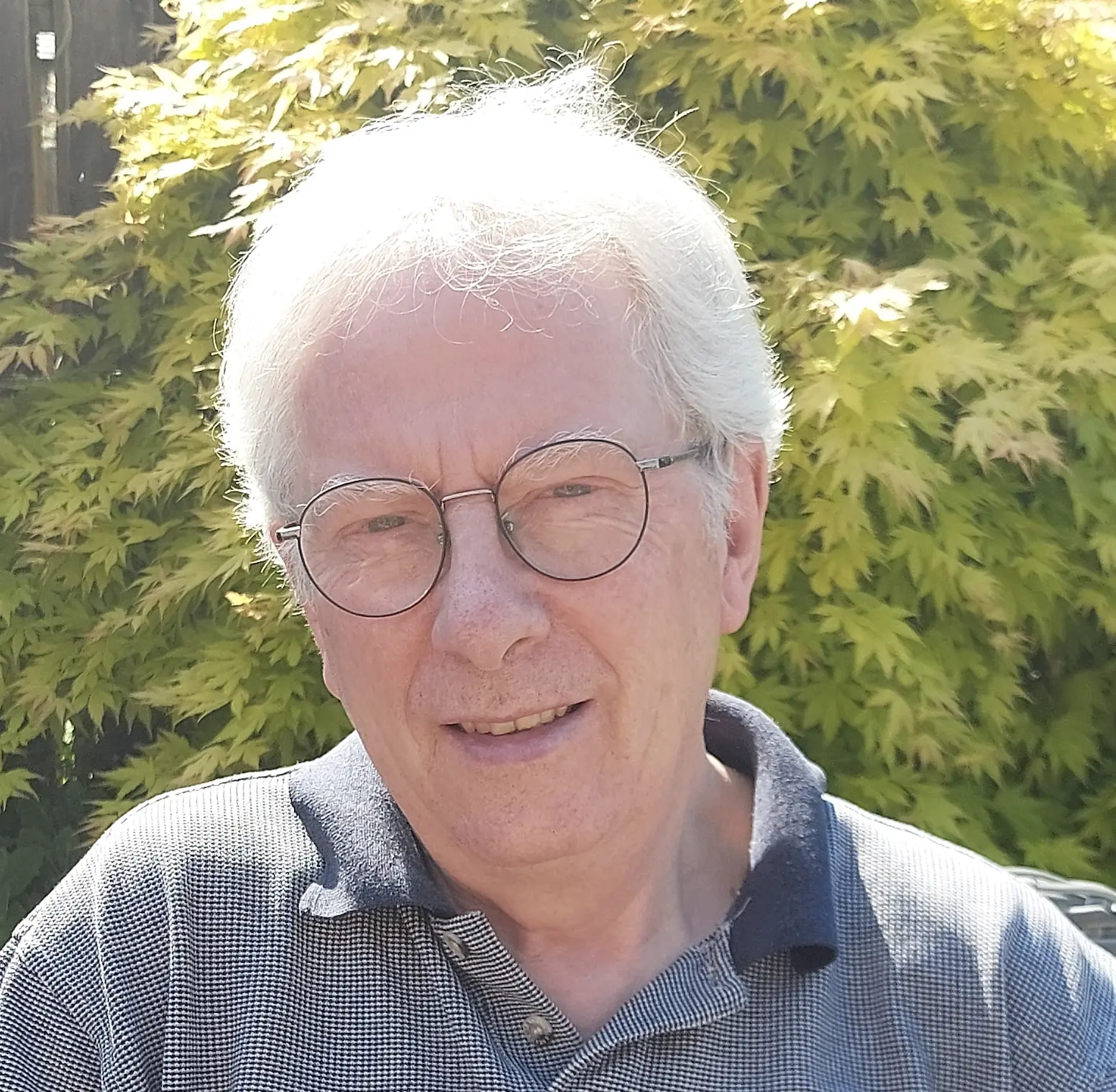
Q: What was the subject of your PhD (1976), and who was your adviser?
A: In 1970, I moved from Belfast, Northern Ireland, to Manchester to study mathematics at the University of Manchester Institute of Science and Technology, UMIST, and to watch Manchester United. By the time I graduated in 1973, I was more successful at the former than the latter. Belfast was in the midst of conflict, and I was playing for the University soccer team, reasons that made me keen to remain in Manchester. David Williams had taught me statistical mechanics in my final year and was hiring his first PhD students. I didn’t know anything about astronomy or astrophysics but had enjoyed David’s lectures, and the topic, modelling chemistry in collapsing interstellar clouds, sounded interesting. I thought I should give it a go. It had the advantage of keeping me in Manchester. I found it a fascinating subject and one which allowed me to continue my university football career. Over 50 years later, I’m still fascinated by astrochemistry and still meet annually with my old teammates.
Q: In the mid/late 1980s you and your collaborators developed a model of chemical processes in cold interstellar clouds, which you applied to various regions, including TMC-1 in Taurus. What did you learn?
A: That was a very interesting and important time for me. After finishing my PhD, I had postdocs in Toronto and Oxford before returning to Manchester. Those five years broadened my knowledge base, in Canada learning about solid state physics and laboratory experiments, and in Oxford, working completely independent of supervision. I then returned to UMIST as an SRC Advanced Fellow. I had realised that my theoretical research needed to be underpinned by building links with radio astronomers and laboratory scientists. Planning for the James Clerk Maxwell Telescope in Hawaii was also well underway, so I decided to spend three months at Onsala Space Observatory and made regular visits to David Smith and colleagues at Birmingham University. They had built the world’s best apparatus for studying ion-molecule reactions. The collaborations formed in those two groups enormously benefitted the direction and development of my career. Along with a PhD student in UMIST, I developed a chemical model for cold, dark clouds. TMC-1 was our primary target as a number of carbon-chain molecules had been found there. Our model turned out to be remarkably successful and we then applied it to a related object, L183(L134N), which has slightly different physical conditions and molecular composition. The major lesson for me was that the underlying chemical networks might be applicable to a range of molecular sources. With another PhD student, I modelled chemistry in the expanding circumstellar envelope of the carbon-rich AGB star IRC+10216. Despite its much different physical conditions, we were again successful in reproducing observations and indeed predicted the presence of other species that were later detected. By this point, I was convinced that all molecular line observations in the Universe would be explained by gas-phase chemistry! It’s not the only time I’ve been wrong.
Q: Around the same time you and your collaborators published a highly cited study of the deuterium fractionation in dense interstellar clouds and concluded that a chemical steady state has not been reached towards Orion.
A: The first deuterated molecules were detected in the mid-1970s and it was quickly recognised that their high relative abundances were due to gas-phase isotopic exchange reactions at very low temperatures. An important aspect of these species is that their D/H ratios can act as probes of the electron fraction, an important parameter in star formation. The increasing number of detections of deuterated molecules and their different D/H ratios provided the impetus to make a deuterium analog of our chemical network, with the involvement of Eric Herbst who had made an extended visit to UMIST. This was the first large-scale model of deuterium chemistry. Because of our time-dependent approach, we were able to follow how deuterium flowed through the chemical system and how processes such as the dissociative recombination of large deuterated ions helped determine the D/H ratios in neutral molecules. We found that these ratios were determined not only by cloud temperature but that they also provided a unique insight into detailed formation and destruction pathways in the synthesis of interstellar molecules.
Q: You have also, together with Eric Herbst, studied the gas-phase chemistry of sulfur-bearing molecules in dense clouds. What were your conclusions and what have observations since then shown?
A: Eric and I had developed independent chemical networks using somewhat different philosophies. The impetus for our initial collaboration came in 1986 when Eric wrote to me suggesting that we try to understand the reasons for our model similarities and differences - not to come to a unified network but to find the strengths and weaknesses in each of our approaches. Competition within a collaboration is always helpful in science. Following this, we worked on many joint projects. Sulfur was a particularly interesting case study. A number of S-bearing molecules had been detected, perhaps not surprisingly, as both atomic and ionised sulfur are very reactive, although - importantly for interstellar chemistry - not with H. The observational challenge is that, although sulfur is essentially undepleted in diffuse clouds, the totality of S-bearing molecules in dark clouds accounts for only 1% of its cosmic abundance, contrary to models which predict that ‘all’ available sulfur should be molecules. This ‘missing’ sulfur continues to be an area of active research.
Q: There is an unusually large abundance of oxygen containing organic molecules in the Orion Compact Ridge within the Kleinman-Low complex which you have studied. What did you learn and has this issue been followed up in the intervening years?
A: In the late 1980s, Steve Charnley, Paul Brown and I began to think about the chemistry of hot molecular cores - small clumps of high density and temperature, then associated with ultra-compact HII regions. These were known to contain saturated molecules, such as NH, CHOH and HS, with abundances enhanced by factors of 1000 or more over those in cold clouds. We suggested that these species formed on cold grain surfaces through simple hydrogenation of atoms in a pre-stellar phase, followed by their desorption through heating by newly-formed stars. The Orion Molecular Cloud contains two hot cores which challenged our interpretation. One, the Orion Compact Ridge, is rich in O-bearing species, the other, the Orion Hot Core, is rich in N-bearing species, together with an under-abundance of O-bearing molecules. Steve Charnley, Xander Tielens and I sought to understand this difference, the more exotic explanation being that, for the Compact Ridge. We argued that the O-rich outflow from the embedded infrared source IRc2 had significantly perturbed the usual gas-phase chemistry. Our problem was not solved, however, because later observations detected large, abundant, complex organic molecules (COMs). These included species such as methyl formate, HCOOCH, as well as doubly deuterated formaldehyde, DCO, seen in the Compact Ridge and which our gas-phase models could not explain. The inference at that time was that these COMs were formed in the ices and subsequently evaporated, a conclusion that ensured that, as Malcolm Walmsley noted in misquoting a famous 1775 aphorism by Dr Samuel Johnson, ‘grain surface chemistry is the last refuge of the scoundrel’. Steve, Xander and I were determined not to be scoundrels, realising that if we included methanol as a surface species, we could explain the origin of the COMs through gas-phase chemistry following its evaporation. While we were working on the paper there was, if I remember correctly, the first interstellar detection of an IR absorption band from methanol ice. At that time, we thought that solid-state methanol was simply due to the freeze-out of gas-phase methanol. Our view changed, however, over the next ten years, firstly when experiments showed that the main gas-phase route to methanol, or more accurately to protonated methanol, was several orders of magnitude slower than theoretical calculations. I was subsequently involved in a storage-ring experiment, led by Wolf Geppart, that showed that the dissociative recombination of protonated methanol with electrons only produced methanol at 5% efficiency. The conclusion, as of today, is that we do not know a means through which methanol forms in the gas phase. It must be formed on cold grain surfaces, most likely through the hydrogenation of frozen CO. A second conclusion you might draw is that Malcolm would put Steve, Xander and me firmly in the scoundrels camp. I cannot speak for the other two, but I am not yet ready to wear the scoundrels badge and believe there is still much to be discovered about the interplay between gas and ice surface processes.
One interesting aspect that connected deuterium to hot cores was our realisation that high atomic D/H ratios in the gas would result in high atomic D/H ratios on the grain surface and lead to high deuterium fractionation in HCO and the COMs in hot cores.
Q: In the mid-1990s you and your collaborators published the first version of the UMIST Database for Astrochemistry, a compilation that has had a major impact on astrochemical studies, and which is now in its sixth edition. Please describe the goals and the evolution of this project.
A: By the late 1980s, the UMIST group were investigating chemistry in novae (Jonathan Rawlings), shocks (Steve Charnley) and outflows and diffuse clouds (David Williams) in addition to those sources mentioned previously. Each of us had developed our own reaction network and it seemed to me that it would be more efficient, and more future-proofed, for the group to merge these and ensure that we all had a responsibility to keep the chemical kinetic data as accurate and up-to-date as possible. We had interesting discussions on whether or not we should make public our rate file and associated data and codes. In some sense, we would be giving away our competitive advantage but, in the end, we all agreed that it was more important to spread astrochemistry to a wider audience, particularly the observational and chemical communities. Our plan was to update the database every few years but as everyone else moved on, I applied successfully to the SRC for a PhD studentship to help manage data collection. Such funding continued until 2013 and set a natural time-scale of 4-6 years for each new release. Since then, I have done this mostly alone, originally alongside my day job as Dean of Engineering and Physical Sciences at Queen’s University Belfast where I moved in 2006. I was fortunate to have some talented individuals, Martin Cordiner, Hideko Nomura and Catherine Walsh, in my group and they kept me involved in studies of protoplanetary disks and AGB stars. My managerial responsibilities ended in 2017, semi-retirement followed in 2019 and full retirement arrived in 2023. This allowed me to devote much more time to data collection, analysis and collation and enabled the 6th release in 2024 (https://umistdatabase.net). This release took much longer than I anticipated because of the incredible number of new molecular discoveries, over 100 in the past 5-6 years, mostly driven by line surveys of TMC-1 led by Pepe Cernicharo and Brett McGuire. In 2019 I decided that, if I could find information on their gas-phase formation, I would include as many as possible of these new species in the database. The pace of discovery was, and continues to be, so rapid that I often found myself ‘cursing’ them both for delaying the 2024 release! In that, the total number of species and reactions increased by 55 and 40%, respectively, over those in the 2012 version.
It has been a very successful project for over 35 years, benefitting an ever-growing astrochemical community and beyond. As new data becomes available and new species are discovered, you can still find me in my study — far too often and for far too long according to my wife — working on the next release, which I estimate contains about 260 of the 340 molecules detected to date. I should stress that this is not data collection for the sake of it. In each release, I include updated models of both TMC-1 and IRC+10216 to see how predictions compare to the observational data of around 200 different molecules across both sources. These identify species whose abundances are far below those observed and thus point to systems where additional laboratory or theoretical data can make a significant difference to our understanding of astrochemistry.
Q: What are you currently working on?
A: I continue to keep the UMIST Database for Astrochemistry up-to-date and relevant to the interpretation of current observations and to motivate the chemical community to study key reactions. I am also very keen to keep the name of UMIST in the literature. I spent 30 years on its campus before it merged with the University of Manchester in 2004. These were some of the most happy and rewarding years of my life, and I feel a duty to mark the contributions of the many PhD students, postdocs and academic staff, most of whom are unnamed here, in turning astrochemistry at UMIST from an uncertain beginning with one lecturer, David Williams, into a world-leading research group.
Other than the database, I’ve been mainly working on the chemical implications of an ALMA Large Programme, ATOMIUM, which has observed the molecular content of the inner circumstellar envelopes of 16 oxygen-rich, late-type stars. Surprisingly, most have outflows which are non-spherical and appear to have been caused by perturbations from a binary companion. With Marie Van de Sande, I’ve been looking at the influence of UV radiation from stellar companions on the molecular composition of the inner circumstellar envelope. ALMA probes such regions very well and we have been able to explain some unusual molecular distributions. This included the detection by ALMA of high energy HCN lines in the warm (200 K) inner envelope of IRC+10216, within 100au of the central star. At this distance, the gas is completely shielded from the external interstellar UV radiation field which drives the formation of the many molecules seen in the outer envelope. In a paper with Mark Siebert, Tony Remijan and Marie, we showed that it could be explained if UV radiation was supplied by a solar-like companion.
I still retain an interest in protoplanetary disk chemistry. My first foray into this field was in 1997 when Karen Willacy and I started a collaboration with Thomas Henning and Hubert Klahr. Hideko Nomura held postdocs with me in Manchester and Belfast and we developed a detailed chemical disk model in preparation for ALMA. Catherine Walsh, my first PhD student at Queen’s, also contributed both to the models and ALMA proposals. In 2016 she brought me back to the ‘scoundrel’ years by making the first detection of methanol in a protoplanetary disk. I also find it rewarding to support PhD students. I’ve been fortunate in recent years to hold an award from the Chinese Academy of Sciences that allowed me to collaborate with the students and postdocs in Xiaohu Li’s group at Xinjiang Astronomical Observatory. I think it is very important for astrochemistry to enthuse the next generation of research leaders and that our collaborations involve colleagues in other disciplines whose dedicated work supplies the fundamental data we need.
When I started out in astrochemical research in 1973, I had no idea that this would be my life’s work. I could not imagine that TMC-1 and IRC+10216 would still be central to my research 50 years later, nor that astrochemistry would have a central role to play in understanding the Universe, near and far. I was very fortunate to get a foot in the door at the birth of the subject and work with some very talented individuals during my career, and more fortunate still that many remain very close friends.