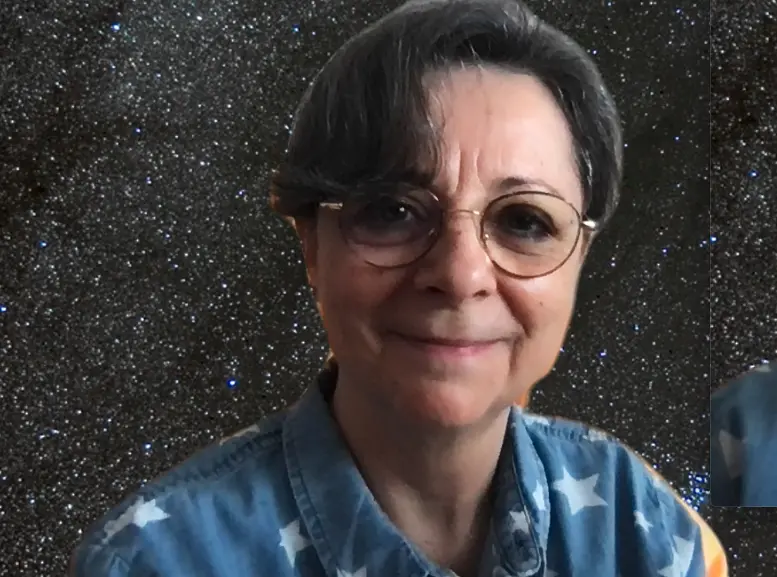
Q: You grew up and studied in Italy, but have made your career in France, in Bordeaux and Grenoble.
A: Indeed, I started my career in Italy, where I spent about 10 years in Frascati as permanent staff at CNR (Consiglio Nazionale delle Ricerche), and moved to France relatively late for family reasons. It was not an easy transition, as I changed not only the country but also changed scientific direction, moving to astrochemistry and millimetre line observations, in addition to having two young kids (a 2 year old girl and one newborn baby). For all these reasons it took some time, but the Laboratoire d’Astrophysique de Grenoble, now called IPAG (for Institut de Planétologie et d’Astrophysique de Grenoble), was welcoming and extremely fertile in ideas and competences. Importantly, I was fortunate to meet Alain Castets, who introduced me to the field of astrochemistry and with whom I had a great collaboration and fun. The second person that played an important role in my transition was Emmanuel Caux at CESR (now IRAP) in Toulouse, with whom I continued to work on the data from ISO (Infrared Space Observatory), a project that I had contributed to build when I was in Italy (I was responsible for the on-board software of the Long Wavelength Spectrometer).
Q: What was your PhD about, and who were your most important early influences?
A: My thesis was on observational cosmology, on the Cosmic Background Radiation (CBR) field, and specifically on the Sunyaev-Zeldovich effect. I worked on the analysis of data from balloon-born telescopes (we published the first articles on the CBR intermediate-scales and quadrupole anisotropies) and on the realization of new instruments for the CBR study. Although these topics are very far away from my present field of research, I learned a lot during that period and everything was useful in my later career in one way or another. First, during those years, I developed a real enthusiasm for research, I learned that patience is necessary to obtain results (during my thesis, I worked on instruments and this requires a lot of patience), and, last but not least, I realized the importance of intuition, to understand and explain with simple ideas and calculations complex problems. I think that this was the great education I received from my supervisor, Francesco Melchiorri. In those years, I also learned the importance of team-work. Nobody (at least that I know) possesses all the expertise necessary to attack and solve important problems, only the exchange of ideas and coordinated efforts can. Then, I had the enormous luck to work with David Hollenbach and Xander Tielens when I was at NASA Ames, in California. I consider them my Giant Teachers regarding the interstellar medium, star formation and molecular astrophysics.
Q: The protostar IRAS 16293-2422 has played an important role in your research, as it has for many other researchers. Do you think IRAS 16293-2422 is a special object, or in a special evolutionary stage, or is it just very close and therefore more easily accessible?
A: IRAS 16293-2422 is the solar-type protostar where we measured an extreme molecular deuteration and discovered the first hot corino, with numerous and abundant interstellar complex organic molecules, also known as iCOMs. These two characteristics is why this object has since been so much studied. It is true, it represented my pet object at the end of 1990s and beginning of 2000s. One of the reasons why IRAS 16293-2422 was and still is a much studied object is indeed that it is close and has a relatively massive envelope, probably because it is indeed very young. At the beginning of the 2000s, the sensitivity of the telescopes, both single-dish and interferometers, completely biased/limited the choice of the object to study and IRAS 16293-2422 has a bright line spectrum. Nowadays, facilities such as IRAM/NOEMA and ALMA have allowed the study of many more young protostars and hot corinos. Still, several other colleagues in the world have since carried out a huge number of other studies towards IRAS 16293-2422, for always the same reason: bright lines. All these new studies show that, indeed, IRAS 16293-2422 does not necessarily represent the “average” solar-type young protostar, the same way that Orion KL does not represent the average massive young protostar.
Q: You have taken a particular interest in deuteration, as outlined in your major reviews for Protostars and Planets V and VI. What have been your main insights, and where is that subject headed?
A: In the 90s models did not predict the observability of multiply deuterated molecules, which were thought to have a too low abundance. Indeed, the detection of large abundances of doubly and triply deuterated species was a huge surprise and triggered a change in the models, recognizing the role of the doubly and triply deuterated isotopologues of H. I think that the HD detection toward the prestellar core L1544 in 2003 was the final demonstration that extreme deuteration takes place in the cold solar-type prestellar cores and that solar-type protostars are much more enriched in deuterated molecules than massive protostars, which were previously the preferred targets for such searches because brighter in other lines. Although the basics of the observed molecular deuteration is now understood, thanks also to several experimental and theoretical works, there are still a few pieces of the puzzle missing, such as the processes of abstraction of hydrogen atoms on the surfaces of the interstellar ices or how the kinetics of the reactions impacts the deuteration in molecules formed in the gas-phase. Two reasons make it important to understand the origin of the observed large molecular deuteration: (i) it provides us with very stringent constraints on the pre-collapse phase of the relevant object and on its evolution; (ii) molecular deuteration provides a sort of Ariadne’s thread that allows us to follow the history of the birth and early evolution of the Solar System.
Q: You have extensively used data from ISO. How important was ISO, and what do you see as the major legacy of that satellite?
A: After IRAS, which scanned the entire sky in the IR for the first time and provided us with an important list of IR sources, ISO was the first observatory in the FIR. It allowed us to study the IRAS sources (and more), making maps, SEDs and, even more innovative, high- to moderate- resolution spectra from IR to FIR. It was a revolution in several fields, from the studies of the ices to the line spectra of galactic and extragalactic objects, which allowed us to understand the gas cooling mechanisms, the distribution of the oxygen, the most abundant element after hydrogen and helium, in molecules, and allowed the first studies of several water lines. Regarding astrochemistry, it was revolutionary: for example, before ISO, models predicted large, observable quantities of water and molecular oxygen in cold molecular clouds, but only stringent upper limits were obtained, causing a drastic revision of models. After a few years of vivid discussion, the community converged on stating that oxygen is mostly frozen in water ices enveloping the dust grains, which is now taken for granted. The successive satellites, SWAS, ODIN and Herschel, confirmed the basic discoveries of ISO on this subject.
Q: One of your most-cited papers deals with far-infrared line emission from collapsing protostellar envelopes. Has Herschel vindicated your views, and what has Herschel contributed in this area?
A: Basically yes, the protostellar envelopes contain large, observable amounts of water and, as predicted, water is particularly abundant in the inner regions where the dust temperature is high enough for the grain mantles to sublimate in the hot corinos. This is important not only because it confirms that water is a very abundant molecule in all solar-type protostars but also allows us to probe the inner regions, where water can play a major role in the gas cooling. Obviously, Herschel has provided us with many more details showing that the reality is complex, as water is not only present in the protostar envelope, but also in the shocks caused by the interaction of the outflowing material with the quiescent envelopes and the cavities opened by them.
Q: Water line emission has been a focus of your work for many years. Is this a direction you maintain?
A: Although water has indeed been a focus of my work during the ISO epoch, at a time when nothing was known about it as we did not have observations, lately astrochemistry in general has attracted my attention, especially the information that we can extract from the observations of young protostars and that can help to understand the first phases of the Solar System’s life. That said, in the last few years I came back to the water in solar-type star forming regions and, in particular, its transition from solid- to gas-phase, which determines the snowline, for example, in protoplanetary disks. This transition depends on the so-called binding energy, namely the energy necessary for a water molecule to leave the surface in which it is adsorbed. In collaboration with chemists, we have calculated the binding energy in a grain covered by water ice and found that it is not a single value but rather a gaussian distribution. This has a great impact on the snowline of disks, and results in a diffuse rather than a sharp gas-solid transition. We also studied the impact of such a binding energy distribution on the origin of terrestrial water and found that a small fraction of water molecules (those with the largest binding energies) is preserved frozen even at the terrestrial orbit during Earth’s formation.
Q: Herschel obviously has revolutionized mid- and far-infrared spectroscopy. What has been your main interest among the wealth of Herschel data?
A: My interest was especially focused on the chemical diversity of protostellar objects, which depends on their evolutionary status and mass. I coordinated the Herschel Key Program CHESS (Chemical Herschel surveys of star forming regions), which used the high-resolution spectrometer HIFI to obtain unbiased 500—2000 GHz spectra in a dozen protostars with an unprecedented spectral resolution. These are the frequencies where water and many other species, especially hydrides, emit lines many of which are not detectable with groundbased telescopes. Several results were obtained by the CHESS team, on the deuteration of water, and on the chemistry of nitrogen and chlorine, to mention a few examples. Actually, many results triggered other projects then carried out with ground-based telescopes to extend the spectral coverage to the millimeter and to spatially disentangle the emission observed with Herschel.
Q: Since Herschel, other facilities have seen the light, again revolutionising our understanding of astrochemistry, for example, IRAM/NOEMA and ALMA. What has been the focus of your studies with them?
A: IRAM/NOEMA and ALMA have been game changers in several fields, thanks to their great sensitivity and spatial resolution. Over these last years, I have been drawn more and more to understanding interstellar organic chemistry and have used both instruments towards this goal. For example, our group co-coordinated three Large Programs: IRAM-30m ASAI (Astrochemical Surveys At Iram), IRAM/NOEMA SOLIS (Seeds Of Life In Space) and ALMA FAUST (Fifty AU STudy of the chemistry in the disk/envelope systems of solar-like protostars). Despite the huge progress in this field, we are still debating what are the exact routes of formation of the interstellar complex organic molecules. This is a fascinating problem and, to solve it, I have started collaborating with chemists, notably Nadia Balucani, Piero Ugliengo and Albert Rimola.
Q: In recent years, your research has involved more and more interdisciplinary work with chemists.
A: In order to solve problems in astrochemistry, so different from the terrestrial chemistry, it is essential to ask for the help of chemists, only a close interaction can lead to progress. Also collaborations with instrumentalists, who build new instruments, with modelers and with data scientists, who use the chemical and observational data to verify our understanding, are required. In this vein, from 2019 to 2023 I led a European network of 13 institutes and 17 PhD students, called ACO (AstroChemical Origins), generously funded by the European Commission, where astronomers, instrumentalists, chemists, modelers and data scientists worked together. Very recently, I have also started collaborating with cosmochemists, notably Pierre Beck. The present chemical composition of the bodies of the Solar System provides precious information on its past history if we can correctly link it to the chemical evolution of similar planetary systems forming nowadays around us. Remarkably, it works also the other way around: the present chemical composition of the Solar System bodies can help to understand processes in the presently forming planetary systems. One illustrative example is given by the terrestrial water origin. When combining our studies on the early formation and chemical evolution of solar-like planetary systems with the chemical properties of frozen water calculated by chemists, and with the measurements of the water content in carbonaceous chondrites, we came to the conclusion that terrestrial water could have been entirely inherited by the coagulation of “not-completely dry” dust grains in the terrestrial orbit, without a contribution from outer Solar System bodies. This is a radical new view, which we published in two articles led by Lise Boitard-Crepeau over the past two years, which could not have been reached without this large interdisciplinary effort.
Q: You had an important leadership role as the head of the AstroMol group in Grenoble. With cutbacks everywhere, do you still encourage young people to enter science and get a PhD in astrochemistry?
A: Let me first clarify that, indeed, I was the head of the AstroMol group when it was formed in 2003 but other members have also led it since then. That said, I am still engaged in promoting molecular astronomy and, in particular, astrochemistry, via teaching, supervising PhD students and via general public seminars and articles. Astrochemistry is a particularly fascinating field to me, in the first place because of the possible implications for the emergence of life on Earth and other planets. However, I ended up finding astrochemistry fascinating per se. For example, it is the realm of quantum physics: molecules and effects that are difficult, if not impossible, to reproduce in terrestrial laboratories are present in the interstellar medium leading to amazing processes and products. Its study, therefore, allow us also to widen our knowledge of quantum physics. In addition, astrochemistry, as science in general, has important practical applications, e.g. in chemistry, and even in society.
Q: France has, I believe, a larger fraction of women in astronomy than most other countries. Is this a cause for celebration, or are there still barriers to be crossed?
A: According to a study by the French Astronomical Society in 2025, in France female astronomers with a permanent position account for about 27% and non-permanent for about 30%, which already rises a red flag. So I do not think that these numbers are something to celebrate, since women constitute 50% of the population. Several studies have shown that the major problem comes from the physical, mental and emotional extra burden on women’s shoulders from taking care of children and, more generally, family and house. As a result, women tend to decline positions of responsibility. I want here to take the opportunity to say to young women who wish to become astronomers that there are many women who succeeded to have a family and a career in astronomy: we can have children and husbands if we wish and still be astronomers.